What Are Music Royalties? How Streaming Payments Work in 2026
Music royalties explained simply. Learn how streaming payments, mechanical, performance, and sync royalties work in 2026, and how to collect every dollar your music earns.
What Are Music Royalties?
Quick answer: Music royalties are payments owed to rights holders (songwriters, performers, publishers, and labels) every time their music is used commercially. They are the financial backbone of the music industry, covering everything from a Spotify stream to a song placed in a Netflix series.
Every time someone streams your track, plays it on the radio, performs it live, or syncs it to a video, a royalty is generated. The amount depends on the type of use, the platform, and the agreements in place between the rights holders and the entities distributing or broadcasting the music.
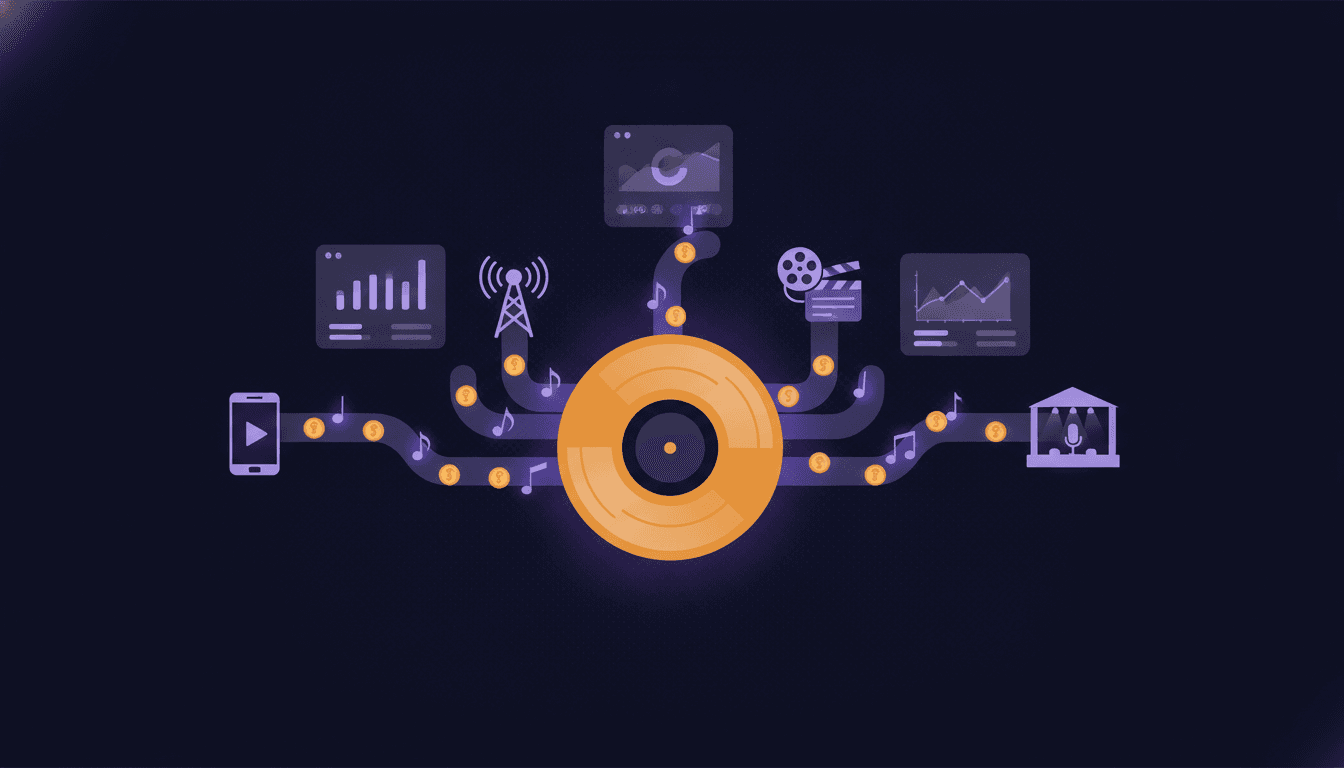
Here is what makes royalties complex: a single song can generate multiple royalty types at once. A Spotify play triggers both a recording royalty (paid to the label or distributor) and a publishing royalty (paid to the songwriter or publisher). A sync placement in a TV show triggers a separate fee entirely. Understanding which royalties you are owed, and from whom, is the first step to collecting every dollar your music earns.
The global recorded music market generated $28.6 billion in 2024, with streaming accounting for 67% of that total. If you are not tracking every royalty type, you are almost certainly leaving money uncollected.
The Main Types of Music Royalties
Quick answer: There are four primary royalty types: mechanical, performance, sync, and digital performance (streaming). Each one pays different rights holders through different collection channels, and missing even one means lost revenue.
Mechanical Royalties
Mechanical royalties are generated every time a song is reproduced. That includes physical copies (vinyl, CD), digital downloads, and on-demand streams. The term dates back to the era of mechanical piano rolls, but today it mostly applies to streaming and downloads.
In the United States, the Copyright Royalty Board sets statutory mechanical rates. For physical and digital sales, the rate is 12.40 cents per song (for tracks under five minutes) as of 2026. For interactive streams, the rate is a percentage of the platform's revenue, allocated proportionally.
Mechanical royalties flow to songwriters and publishers. They are collected by mechanical rights organizations or your publishing administrator. If you self-publish, you need to register with a collection society or admin service to receive these payments. Without registration, platforms hold your mechanicals in escrow, and unclaimed funds can sit for years before being redistributed.
For a deeper look at how your music reaches streaming platforms in the first place, read our guide to music distribution.
Performance Royalties
Performance royalties are earned when a song is performed publicly. "Publicly" covers a wide range: radio airplay, live concerts, background music in restaurants, streaming on interactive platforms, and even music played in a gym or retail store.
Performance Rights Organizations (PROs) collect these royalties. In the U.S., the major PROs are ASCAP, BMI, and SESAC. Internationally, each country has its own collecting society. PROs license venues, broadcasters, and platforms, then distribute royalties to registered songwriters and publishers.
Both the songwriter and the publisher receive performance royalties, split according to their agreement. If you wrote the song and own your publishing, you collect both shares. Most PROs pay quarterly, with a reporting lag of several months between the performance and the payment.
One common gap: many independent artists register with a PRO for their writer share but forget to register a publishing entity for the publisher share. That missing half sits uncollected.
Sync Royalties
Sync (synchronization) royalties are one-time fees paid when music is licensed for use alongside visual media. Film, TV, commercials, video games, YouTube videos, and social media content all fall under sync licensing.
Unlike mechanical and performance royalties, sync fees are negotiated individually. There is no statutory rate. A song placed in a Super Bowl ad commands a very different fee than a track licensed for an indie short film. Factors include the prominence of the placement, the media's reach, the duration of use, and the popularity of the song.
Sync licensing requires approval from both the master recording owner (usually the label or the artist, if independent) and the composition owner (the publisher or songwriter). Both parties negotiate their own fees independently.
For artists and labels, sync placements are valuable beyond the upfront fee. A well-placed song in a popular series can drive millions of streams within days. To understand how sync licensing works in detail, check out our sync licensing explainer and our guide to what a sync agent does.
Digital Performance / Streaming Royalties
Digital performance royalties cover non-interactive digital transmissions. Think internet radio (Pandora's non-interactive stations), satellite radio (SiriusXM), and cable music channels. These are distinct from the interactive streaming royalties generated by on-demand platforms like Spotify or Apple Music.
In the U.S., SoundExchange collects digital performance royalties for sound recording owners and featured artists. The statutory split is 50% to the sound recording owner (label), 45% to the featured artist, and 5% to a fund for session musicians and backup vocalists.
Registration with SoundExchange is separate from your PRO registration. Many artists assume their PRO covers all digital royalties. It does not. SoundExchange handles the recording side of non-interactive digital performances only. Missing this registration means forfeiting 45% of the artist share from satellite and internet radio plays.
How Streaming Royalty Payments Work in 2026
Quick answer: Streaming platforms pay rights holders based on their share of total platform streams, drawn from a revenue pool funded by subscriptions and ads. Per-stream rates vary by platform, tier, and country, typically ranging from $0.003 to $0.012 per stream.
Per-Stream Rates by Platform (Comparison Table)
Streaming royalties are not a fixed rate. They fluctuate monthly based on total platform revenue, subscriber count, and the total number of streams in that period. The figures below represent estimated average per-stream payouts for 2025/2026, combining premium and free-tier streams:
| Platform | Est. Per-Stream Rate (USD) | Revenue Model | Notes |
|---|---|---|---|
| Spotify | $0.003 - $0.005 | Freemium + Premium | Largest market share; rate varies by country and tier |
| Apple Music | $0.007 - $0.010 | Paid only | No free tier means higher per-stream average |
| Amazon Music | $0.004 - $0.008 | Bundled + Standalone | Prime bundle streams pay less than standalone subs |
| YouTube Music | $0.004 - $0.007 | Freemium + Premium | Ad-supported streams pay significantly less |
| Tidal | $0.008 - $0.012 | Paid only | Smaller user base, higher per-stream rates |
| Deezer | $0.004 - $0.007 | Freemium + Premium | Testing artist-centric payment model |
These are blended averages. A stream from a premium subscriber in the U.S. pays more than a free-tier stream in a lower-revenue market. Geography, subscription tier, and even the time of year (ad revenue spikes in Q4) all affect the actual payout per stream.
Important: these per-stream figures represent the total payout split between the recording and publishing sides. As an independent artist who owns both, you receive the full amount. If you are signed to a label, your share depends on your contract terms, often 15% to 25% of the master side for traditional deals, or 80% to 100% for distribution-only deals.
Pro-Rata vs. User-Centric Models
The music industry has debated how streaming revenue should be divided for years. Two models dominate the conversation.
Pro-rata (the current standard): All subscription revenue goes into one pool. Each rights holder's payout is based on their share of total platform streams. If your songs account for 0.001% of all streams on Spotify in a given month, you receive 0.001% of the distributable revenue. This model favors artists with massive stream counts. It also means a subscriber who only listens to jazz is effectively subsidizing pop mega-hits they never play.
User-centric payment system (UCPS): Each subscriber's payment is divided only among the artists that subscriber actually listened to. If a user pays $10.99/month and listens to 10 artists equally, each artist gets roughly $1.10 from that subscriber (minus platform fees). This model rewards artists with dedicated, engaged fan bases, even if those fan bases are small.
Deezer began testing a user-centric approach in 2024 with its artist-centric model, which weights payouts toward professional artists and penalizes streams flagged as noise or fraud. Tidal has experimented with fan-centered royalties as well. Spotify, the largest platform, has introduced minimum stream thresholds (tracks must hit 1,000 streams per year to generate royalties) and has deprioritized noise/functional content, but has not fully adopted UCPS.
The shift matters for independent and mid-tier artists. Under pro-rata, your revenue depends on the overall market. Under user-centric, it depends on how engaged your listeners are. Artists with loyal audiences stand to gain significantly from a user-centric model.
Seeing which listeners come back to your tracks is what separates signal from noise. Music24 puts your streams, saves and playlist adds from Spotify for Artists next to every post you made, so you can see what moved them. If you want to understand your real listener engagement, not just your stream count, explore what Music24 can do.
How to Track and Maximize Your Music Royalties
Quick answer: Register with every relevant collection organization, audit your metadata, use a publishing administrator if you self-publish, and monitor your royalty statements for missing income. Proactive tracking can increase your collections by 20% to 40%.
1. Register everywhere. At minimum, register with a PRO (for performance royalties), a mechanical rights organization or publishing admin (for mechanicals), and SoundExchange (for digital performance royalties). International artists should also register with their local collecting societies and consider a sub-publishing deal for foreign territories.
2. Get your metadata right. Every song you release carries metadata: songwriter names, publisher names, ISRC codes (for recordings), ISWC codes (for compositions), and splits. If any of this is wrong or missing, royalties get lost. Platforms cannot pay you if they cannot match your song to your registration. Our guide to music metadata breaks down exactly which fields matter and how to verify them.
3. Use a publishing administrator. If you own your publishing but do not have a traditional publishing deal, a publishing admin (like Songtrust, Sentric, or CD Baby Pro) will register your songs with collection societies worldwide and collect mechanicals and performance royalties on your behalf. They typically charge 10% to 20% of collected royalties, a reasonable trade for global coverage you would struggle to manage alone.
4. Audit your statements. Compare your distributor statements against your PRO statements and your SoundExchange payments. Look for songs that are streaming well but not generating corresponding publishing royalties. Gaps usually mean a registration issue.
5. Track playlist adds and saves, not just streams. A song that gets added to private playlists and saved by listeners generates long-tail royalties for months or years. A song that spikes from a viral moment but never gets saved drops off quickly. Understanding which of your tracks have staying power helps you prioritize catalog promotion and plan future releases.
For a broader framework on turning listener data into career decisions, read our music analytics workflow guide.
Common Mistakes Artists Make with Royalty Collection
Quick answer: Most uncollected royalties trace back to five preventable errors: incomplete registrations, bad metadata, ignoring the publishing side, not collecting internationally, and failing to audit distributor statements.
Skipping publisher registration with your PRO. Your PRO has two shares: the writer share and the publisher share. If you do not register a publishing entity and claim the publisher share, that 50% of your performance royalties goes uncollected. This is arguably the most common mistake independent artists make.
Releasing music with incorrect or incomplete metadata. A misspelled songwriter name, a missing ISRC code, or an incorrect split percentage can prevent royalties from being matched to your account. Once a song is distributed with bad metadata, fixing it across all platforms takes months. Get it right before you release.
Ignoring international collection. Your PRO collects domestically, but international performance royalties require reciprocal agreements or a sub-publisher in each territory. Without international coverage, plays on European radio, Asian streaming platforms, or Latin American TV go uncollected.
Assuming your distributor handles everything. Your distributor (DistroKid, TuneCore, CD Baby, AWAL, etc.) collects the master recording royalties from streaming platforms. They do not collect your publishing royalties, your performance royalties, or your SoundExchange royalties. Those require separate registrations.
Not auditing royalty statements. Streaming platforms process billions of transactions monthly. Errors happen. Songs get misattributed. Payments get delayed. If you never compare your expected income against your actual statements, you will never catch the discrepancies.
FAQ
How much does Spotify pay per stream in 2026?
Spotify pays an estimated $0.003 to $0.005 per stream in 2026. The exact amount depends on the listener's country, subscription tier (free vs. premium), and the total number of streams on the platform that month. Premium streams in high-revenue markets like the U.S. pay closer to $0.005. Free-tier streams in lower-revenue regions can fall below $0.003.
What are the four main types of music royalties?
The four main types are mechanical royalties (generated when a song is reproduced, including streams and downloads), performance royalties (earned from public performances, radio, and streaming), sync royalties (paid for music used in film, TV, ads, and video games), and digital performance royalties (collected from non-interactive digital radio like SiriusXM and Pandora stations).
Do I need to register with SoundExchange if I already have a PRO?
Yes. PROs (ASCAP, BMI, SESAC) collect performance royalties for songwriters and publishers. SoundExchange collects digital performance royalties for sound recording owners and featured artists from non-interactive streaming services. These are separate income streams with separate registration requirements. Missing SoundExchange registration means forfeiting your share of satellite and internet radio royalties.
What is the difference between pro-rata and user-centric streaming payments?
Pro-rata pools all subscription revenue and divides it based on each artist's share of total platform streams. User-centric divides each individual subscriber's payment among only the artists that subscriber listened to. Pro-rata favors high-volume artists. User-centric rewards artists with dedicated, engaged listeners regardless of total stream counts.
How long does it take to receive streaming royalties?
Most distributors pay streaming royalties 2 to 3 months after the streams occur. Performance royalties from PROs typically arrive 6 to 9 months after the performance, due to reporting and processing delays. SoundExchange pays quarterly with a similar lag. Sync royalties are usually paid upon execution of the license agreement, though payment terms vary by deal.
Why are some of my royalties going uncollected?
The most common reasons are incomplete registrations (missing PRO publisher share, no SoundExchange registration), incorrect metadata (misspelled names, wrong ISRC codes), lack of international collection coverage, and not using a publishing administrator to collect mechanical royalties globally. Auditing your royalty statements against your streaming data is the fastest way to identify gaps.
Can I collect royalties without a record label?
Yes. Independent artists can collect all royalty types by registering with the right organizations: a distributor for master recording royalties from streaming platforms, a PRO for performance royalties, SoundExchange for digital performance royalties, and a publishing administrator for mechanical royalties. You keep a larger share of each dollar collected compared to a traditional label deal.
Releasing music soon? Start free with Music24: 7 days of the Pro plan, no card, then a Free plan for as long as you like. Start your free trial.
Get your music heard. Grow the fans who stay.
Add a song. music24 makes the posts and the videos, plans your release and publishes it on every channel. Free for 7 days on the Pro plan, no card.