
Many A&R executives still treat playlist adds as simple popularity contests, but deeper insights reveal a more dynamic reality. The true influence of playlists lies in how curated song collections steer listener attention and artist discovery long before trends emerge on public streaming charts. Dissecting private playlist analytics uncovers authentic listener behavior, empowering global labels to pinpoint rising talent and anticipate shifts in music culture before their competitors do.
Table of Contents
- Playlist Influence Defined And Common Misconceptions
- Private Versus Public Playlists: Key Differences
- How Analytics Reveal Emerging Artist Momentum
- Curator Impact On Genre Blending And Micro-Trends
- Risks, Limitations, And Ethical Considerations
Key Takeaways
| Point | Details |
|---|---|
| Understanding Playlist Influence | Playlist influence shapes artist discovery and market trends, emphasizing curation quality over the quantity of placements. |
| Private vs. Public Playlists | Private playlists provide genuine listener preferences, revealing trends before they surface in public metrics. |
| Data-Driven Talent Scouting | Analytics reveal artist momentum and retention patterns, allowing A&R teams to identify potential breakout artists early. |
| Ethical Considerations | A&R strategies should combine playlist data with diverse sources to ensure a comprehensive understanding of artist potential. |
Playlist Influence Defined and Common Misconceptions
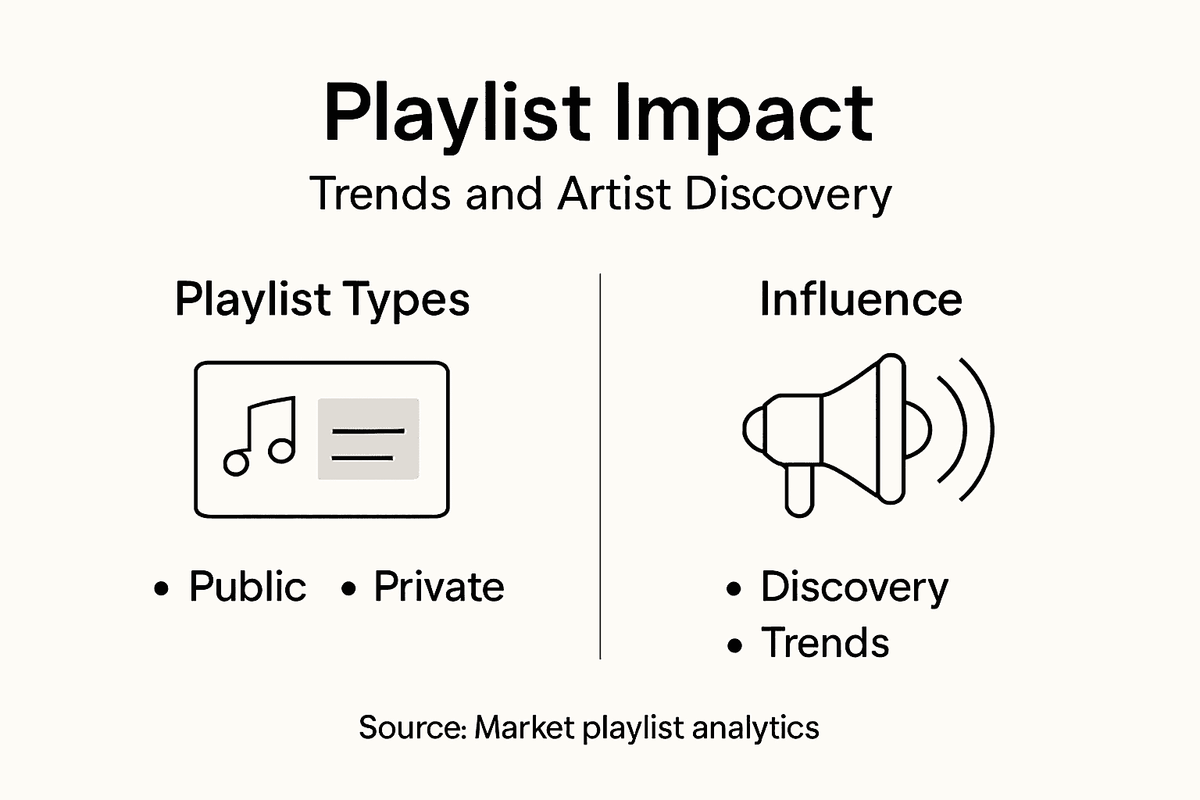
Playlist influence isn't what most A&R teams think it is. The term describes how curated collections shape listener behavior, artist discovery, and market trends—but the mechanics differ significantly from public streaming charts. Many labels mistake playlist placements for guaranteed visibility, missing the deeper role playlists play in breaking artists.
At its core, playlist influence represents the power of song organization and curation to drive discovery patterns before they become visible in public metrics. Playlists function as cultural gatekeepers, directing listener attention and creating momentum for emerging artists. However, playlist coherence and flow determine their actual impact on listener retention far more than track count or curator follower numbers.
Here are common misconceptions holding back data-driven talent scouting:
- "More playlists = faster growth" – Playlist quantity matters far less than curation quality and listener engagement within each collection
- "Algorithm-generated playlists drive trends" – User-created and editorially curated playlists show stronger influence on authentic discovery patterns
- "Public playlist adds equal all artist exposure" – Private playlists reveal emerging preferences weeks or months before public charts reflect them
- "Follower count predicts playlist impact" – A 500-person niche playlist can outperform a 50,000-follower generic playlist for specific genres or demographics
The reality: playlists are far more than song collections. Playlist titles and covers function as cultural statements, shaping listener identity and consumption patterns. When a curator adds a track, they're making a cultural endorsement that signals value to their audience.
For A&R teams, this means analyzing which private playlists feature emerging artists reveals authentic market demand before competitors recognize it. A song appearing in 200 carefully selected indie-rock playlists signals stronger trend potential than placement in 5,000 algorithmic pop playlists.
Private playlist data exposes genuine listener preferences hidden from public streaming metrics, giving labels the competitive edge to identify breakout artists months earlier.
Focus shifts from counting placements to analyzing curator intent, listener retention within playlists, and cross-genre playlist adoption. This distinction separates data-driven label strategies from vanity metric chasing.
Pro tip: When evaluating emerging artists, examine whether they appear in cohesive thematic playlists created by niche curators rather than scattered across generic algorithmic collections—this pattern indicates authentic cultural relevance and sustained growth potential.
Private Versus Public Playlists: Key Differences
Private and public playlists operate under completely different rules, and A&R teams often miss this distinction when analyzing artist traction. Public playlists are performative—curators craft them for social presentation and audience perception. Private playlists reveal what listeners actually love without the filter of social expectation.
This difference matters enormously for talent scouting. Public playlists reflect curated social behaviors, shaped by what curators want to communicate about themselves. A public indie-rock playlist might emphasize critically acclaimed artists to signal taste and credibility. That same curator's private collection likely contains rougher, more experimental tracks that never see public eyes.
Here's what sets them apart:
- Private playlists capture unfiltered musical preferences without social performance pressure
- Public playlists emphasize genre consistency, curator branding, and audience expectations
- Private discovery happens weeks or months before trends appear in public metrics
- Public playlists serve as marketing and identity statements, not pure listening records
For emerging artists, this creates a critical advantage. A song gaining traction in private playlists signals authentic listener interest before competitors detect it through public data. An emerging hip-hop producer might accumulate 50,000 private playlist adds across niche collections before landing a single public playlist feature.
Private playlists reveal unfiltered musical choices that directly correlate with purchasing power, concert attendance, and long-term fan loyalty. Public playlists often reflect what listeners think they should enjoy, not what they consistently return to.
Labels leveraging private playlist analytics gain months of lead time identifying trends. While competitors chase public chart placements, data-driven teams already recognize which emerging artists have genuine momentum among authentic music enthusiasts.
Private playlists are where authentic music discovery happens—they're the early warning system for trends becoming public reality.
Public playlists matter for visibility and brand building. Private playlists matter for understanding market demand before it's obvious. The winning strategy combines both, using private data to guide artist development and public placement to amplify momentum.
Here's a comparison of how private and public playlists impact artist discovery and label strategy:
| Aspect | Private Playlists | Public Playlists |
|---|---|---|
| Listener Behavior Insight | Reveal genuine preferences early | Reflect socially influenced choices |
| Market Advantage | Provide lead time for scouting | Offer broad visibility for artists |
| Data Value | High for trend detection | High for brand amplification |
| Typical Usage in A&R | Early-stage artist validation | Mainstream promotional efforts |
Pro tip: Prioritize emerging artists appearing consistently in private playlists created by niche curators over those heavily featured in high-follower public collections—private adoption indicates sustained listener interest rather than one-time algorithmic exposure.
How Analytics Reveal Emerging Artist Momentum
Analytics transform artist discovery from guesswork into measurable science. The numbers tell you which emerging artists have genuine market traction before they break through to mainstream awareness. A&R teams that master this data gain months of lead time on competitors still relying on radio feedback and social media hunches.

Momentum isn't random. It leaves traceable patterns across multiple data points that compound over time. When you see streaming metrics showing increased plays and listener engagement, you're observing real human behavior—people repeatedly returning to an artist's music, adding songs to personal collections, and sharing them within networks.
Here's what revealing analytics track:
- Playlist velocity – How quickly an artist gains adds across private and public playlists over 30, 60, and 90-day windows
- Listener retention – Whether new listeners return for additional plays or disappear after one exposure
- Geographic clustering – Which regions show disproportionate engagement, signaling localized trend potential
- Cross-genre adoption – Artists appearing in unexpected playlist contexts indicate broader cultural appeal
- Demographic concentration – Listener age, gender, and lifestyle indicators reveal target audience alignment
Real momentum shows consistency across multiple vectors. An emerging artist might see 200 new private playlist adds in week one, then 180 in week two—not exponential but steady. That pattern beats an artist with 5,000 playlist adds in week one followed by a cliff drop to 50 adds in week two.
The artists gaining sustainable momentum show steady, multi-vector growth across playlists, listener retention, and geographic spread—not viral spikes that collapse within weeks.
Traditional gatekeepers evaluated artists through subjective taste. Analytics provide objective proof of audience interest. A label can now identify which emerging hip-hop producer has accumulated 100,000 private playlist adds across niche collections, signaling authentic demand before any major label pays attention.
This shifts A&R strategy from "Who do we think is talented?" to "Which emerging artists are listeners already choosing?" The data answers questions months before traditional metrics reflect the trend.
Pro tip: Track emerging artists across 90-day rolling windows to distinguish authentic momentum from artificial playlist spikes—consistent growth indicates sustainable trend potential worth investing in compared to one-week viral surges.
This table summarizes how analytics support better A&R decisions throughout the artist scouting process:
| Analytics Focus | Role in Discovery | Result for A&R |
|---|---|---|
| Playlist Velocity | Tracks rate of song adds | Identifies fast-rising talent |
| Listener Retention | Measures repeat engagement | Highlights lasting fan interest |
| Cross-Genre Spread | Detects new audience groups | Spots artists with broad appeal |
| Geographic Clustering | Finds regional trends early | Targets high-potential markets |
Curator Impact on Genre Blending and Micro-Trends
Curators don't just organize songs—they reshape how entire genres evolve and intersect. A single curator's playlist decisions cascade through listener networks, creating genre-blending patterns that become tomorrow's mainstream trends. For A&R teams, understanding curator influence reveals emerging micro-trends months before they register on public radar.
Genre boundaries are collapsing. What once separated indie rock from electronic music or hip-hop from country now blends seamlessly. Genre-bending results from musical and cultural elements interacting globally, and curators accelerate this evolution by intentionally pairing unexpected tracks in playlists. When a curator adds an emerging trap artist next to a folk singer, they're not just creating juxtaposition—they're validating hybrid appeal to their audience.
Micro-trends emerge from curator decisions:
- Genre fusion playlists introduce listeners to hybrid styles before mainstream classification exists
- Cross-demographic curation exposes niche audiences to artists outside typical target markets
- Thematic clustering groups emerging artists around cultural moments or sonic characteristics
- Geographic experimentation surfaces regional sounds to global audiences through intentional playlist architecture
Consider a curator who creates a private playlist blending lo-fi hip-hop with ambient production and indie vocals. That single collection might include three emerging artists no major label has signed. If that curator has influence within music communities, similar curators replicate the pattern, and suddenly genre-blending becomes identifiable trend with measurable artist traction.
Private playlists reveal these patterns before public recognition. A&R teams tracking curator activity detect which emerging artists gain traction across genre-blending contexts. An emerging R&B artist appearing consistently in playlists mixing soul, electronic, and indie elements signals broader appeal than one confined to traditional R&B playlists.
Curators drive genre evolution by validating unexpected combinations—emerging artists gaining traction across genre-blending playlists demonstrate transcendent appeal worth investing in.
Micro-trends born from curator decisions have real commercial value. Labels identifying these patterns early position artists within emerging movements before they become saturated. The curator influence extends beyond playlist adds—it shapes how audiences perceive and consume music categories.
Pro tip: Monitor emerging artists appearing consistently across genre-blending private playlists created by influential curators—these placements signal authentic cross-genre appeal and indicate artists with potential to define emerging micro-trends.
Risks, Limitations, and Ethical Considerations
Playlist data is powerful, but it carries real risks. A&R teams using private playlist analytics gain competitive advantage, yet they must understand the ethical pitfalls embedded in this data. Ignoring these limitations leads to poor decisions disguised as data-driven strategy.
Algorithmic systems reflect the biases of their creators and training data. Recommendation systems risk reducing music discovery and disadvantaging independent artists by concentrating visibility among already-established artists. When playlists systematically favor certain demographics, regions, or genres, the data becomes a mirror of existing inequalities rather than a window into authentic listener preferences.
Key risks affecting your artist scouting:
- Geographic bias – Dominant markets receive disproportionate playlist attention, masking emerging talent in underrepresented regions
- Filter bubbles – Playlists reinforce listener preferences rather than challenging them, obscuring genuinely innovative artists
- Commercial influence – Playlist placements reflect payola, label relationships, and platform economics—not purely listener behavior
- Self-selection bias – Private playlists are created by specific demographics, potentially misrepresenting broader audience interest
- Opacity – Algorithmic fairness concerns persist due to lack of transparency in how playlists are constructed and ranked
Playlist data alone shouldn't drive signings. An emerging artist might show strong momentum in indie-rock private playlists yet lack broader commercial viability. Conversely, an artist appearing in fewer playlists might possess genuine innovation that curators haven't discovered yet.
Playlist analytics reveal curator preferences and algorithmic patterns, not universal truth about artist talent or market potential.
Transparency matters. Labels should question where emerging artists appear most heavily. Are they gaining traction organically, or are playlist placements driven by label investment? Are certain genres, regions, or artist demographics systematically disadvantaged in your data?
Ethical A&R strategy combines playlist data with diverse intelligence sources—artist streaming trajectories, live performance metrics, fan community engagement, and authentic listener feedback. Use private playlist analytics to identify promising candidates, then validate those discoveries through multiple lenses.
Pro tip: Cross-reference emerging artists showing strong private playlist momentum against independent metrics like organic social growth and regional concert attendance to validate that growth signals genuine market demand rather than algorithmic artifacts.
Discover Genuine Artist Momentum with Music24's Private Playlist Analytics
The article reveals how traditional public playlists only show a fraction of the real listener preferences and how private playlists expose authentic early trends long before mainstream charts catch on. If you are an A&R team or music professional struggling to identify breakout artists amid misleading metrics such as viral spikes or algorithmic noise, you need a tool designed to decode playlist influence and curator impact with precision.
Music24.com specializes in analyzing millions of anonymized private playlists to uncover true market demand, genre blending, and emerging micro-trends that drive sustainable artist growth. Our platform transforms subjective scouting into objective insight by tracking playlist velocity, listener retention, and cross-genre adoption. With Music24’s proprietary data, you gain a competitive edge identifying talent months before public visibility.
Ready to leave behind guesswork and discover which emerging artists have authentic momentum?

Explore how Music24’s in-depth private playlist analytics empower data-driven talent discovery and strategic marketing. Visit Music24 today and unlock the future of music scouting. Learn more about leveraging playlist influence and detecting genre blending micro-trends within a centralized platform built for the evolving music landscape.
Frequently Asked Questions
What is playlist influence?
Playlist influence refers to how curated collections of songs shape listener behavior, artist discovery, and market trends. It emphasizes the importance of song organization and curation in driving listener engagement and breaking artists, rather than merely counting placements on public streaming charts.
How do private playlists differ from public playlists?
Private playlists capture unfiltered musical preferences and reveal early trends without the pressure of social performance, while public playlists reflect curated choices aimed at audience perception and branding. This distinction is critical for talent scouting and understanding authentic listener interest.
Why are private playlists important for artist discovery?
Private playlists often reveal genuine listener preferences and momentum that can precede public metric visibility. An artist gaining traction in private playlists signals authentic interest and allows A&R teams to identify emerging trends ahead of competitors.
How can analytics improve artist scouting?
Analytics provide measurable insights into artist momentum by tracking playlist velocity, listener retention, geographic clusters, and demographic data. This data-driven approach enables A&R teams to distinguish sustainable growth from temporary spikes, ensuring better artist discovery and development strategies.
Recommended
- Playlist-Driven Discovery: Shaping Artist Breakouts - Blog - Music24.com
- Music Curator Influence: Unlocking Data-Driven Discovery - Blog - Music24.com
- 7 Data-Driven Artist Discovery Tips for A&R Success - Blog - Music24.com
- Music Insights Best Practices for Early Artist Discovery - Blog - Music24.com

