
Curated playlists account for significant streaming revenue and engagement across major platforms, yet most industry professionals underestimate the strategic power of curation networks in shaping artist trajectories. Understanding how independent curators, editorial teams, and algorithmic systems interact to amplify trends provides a competitive edge for A&R executives, managers, and marketers navigating the fragmented music landscape. This article explores the mechanisms through which curation influences discovery, the challenges facing playlist diversity, and actionable strategies for leveraging curation data to identify breakout talent and maximize artist impact in 2026.
Table of Contents
- Understanding Music Curation: Roles And Impact
- How Independent And Algorithmic Curators Influence Music Trends
- Challenges And Nuances In Playlist Curation And Diversity
- Applying Curation Insights For Strategic Music Industry Success
- Discover More With Music24
Key takeaways
| Point | Details |
|---|---|
| Revenue driver | Curated playlists generate substantial streaming engagement and revenue for platforms and artists. |
| Underground validation | Independent curators authenticate emerging tracks before algorithmic amplification occurs. |
| Algorithmic influence | Curation patterns directly shape how recommendation systems surface new music. |
| Club longevity | Human curation through DJ networks and clubs extends trend lifespan beyond streaming spikes. |
| Diversity decline | Algorithmic playlists show reduced stylistic variety, limiting experimental music exposure. |
Understanding music curation: Roles and impact
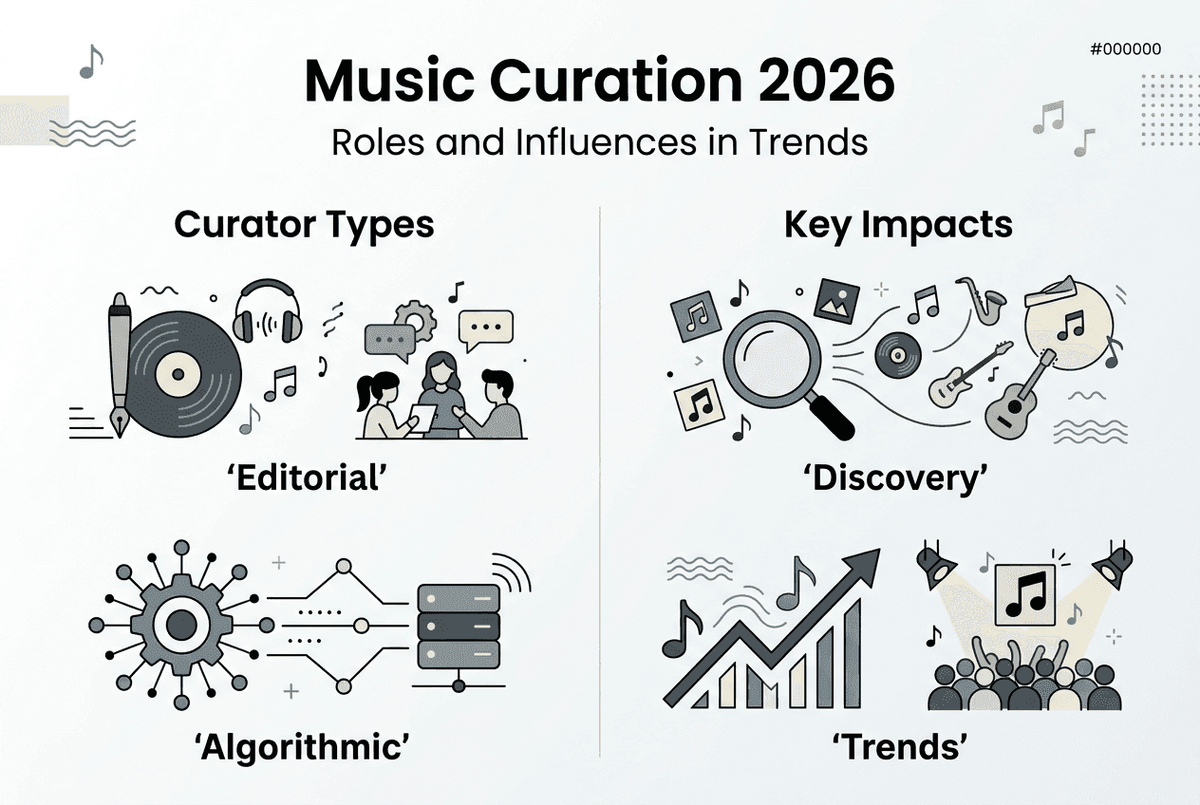
Music curation organizes and presents tracks to create cohesive listening experiences that resonate with specific audiences and moods. Curators tell stories through song selection, sequencing, and thematic coherence, transforming random collections into meaningful journeys that shape how listeners discover and engage with music. This storytelling function builds emotional connections and trust that purely algorithmic systems struggle to replicate.
Editorial and curated playlists significantly drive streaming revenue and user engagement, making them essential tools for platform growth and artist exposure. Listeners place higher trust in human-curated selections because they perceive intentionality, expertise, and cultural awareness behind the choices. This trust translates into longer listening sessions, higher save rates, and stronger artist-fan relationships compared to algorithm-generated recommendations.
Different curator types serve distinct functions within the music ecosystem:
- Editorial curators at streaming platforms control high-visibility placements with millions of followers
- Independent curators build niche communities around specific genres, scenes, or cultural movements
- Brand and media curators leverage music to enhance content and audience engagement
- Club and DJ curators validate tracks through real-world performance and dancefloor response
The role of curators in music discovery becomes increasingly critical as genre fragmentation accelerates and listener attention spans shorten. Human curation provides the contextual framing and quality filtering that helps audiences navigate overwhelming content volumes. Pro Tip: Track which independent curators consistently feature artists who later achieve mainstream success to identify reliable early indicators of emerging talent.
How independent and algorithmic curators influence music trends
Independent curators function as tastemakers who create micro-scenes and validate underground tracks before mainstream platforms recognize their potential. In electronic music particularly, independent curators validate underground tracks by featuring them in dedicated playlists that attract passionate early adopters and scene participants. These curators build credibility through consistent quality, deep genre knowledge, and authentic connection to artist communities.

Algorithmic amplification occurs when curator-created engagement clusters signal quality to recommendation systems, triggering broader distribution. The relationship between human curation and algorithmic discovery creates a feedback loop where initial curator validation generates listener engagement data that algorithms interpret as popularity signals. This symbiotic relationship means neither system operates in isolation.
Comparing reach and influence reveals complementary strengths:
| Metric | Editorial Playlists | Algorithmic Recommendations |
|---|---|---|
| Platform consumption share | 4.4% | 19.1% |
| Follower scale | Millions per playlist | Personalized per user |
| Discovery mechanism | Human selection | Behavioral patterns |
| Trust factor | High cultural authority | High personalization |
Spotify's algorithmic recommendations drive 19.1% of consumption compared to 4.4% for editorial playlists, demonstrating the dominant role of personalized systems in overall listening behavior. However, editorial placements often trigger the initial engagement signals that feed algorithmic amplification, making them disproportionately influential in launching new artists.
The examples of influential curators show how individuals and small teams can shape genre evolution and artist careers through strategic playlist management. Understanding playlist algorithms and trends helps professionals optimize release strategies to maximize both human curator appeal and algorithmic pickup.
Music curator influence on data-driven discovery extends beyond simple playlist placement to include timing coordination, audience targeting, and cross-platform amplification strategies. Pro Tip: Monitor independent curator networks in your target genres at least three months before release to identify ideal timing windows and relationship-building opportunities for maximum impact.
Challenges and nuances in playlist curation and diversity
Spotify Discover Weekly's audio feature diversity has declined significantly since 2021, with playlists clustering around mid-tempo tracks and familiar sonic profiles. This reduction in stylistic outliers limits exposure to experimental music and emerging sounds that fall outside algorithmic comfort zones. The trend toward safe, proven formulas reflects platform priorities around engagement metrics over discovery innovation.
Popularity concentration reduces playlist coherence and discovery potential by favoring already successful tracks over emerging artists:
| Challenge | Impact | Professional Response |
|---|---|---|
| Reduced tempo variance | Fewer energetic or ambient tracks | Seek niche playlists for extremes |
| Declining outlier inclusion | Less experimental music exposure | Monitor underground curator networks |
| Algorithmic bias toward familiarity | Established artists dominate | Focus on pre-algorithmic validation |
Recommender systems exhibit algorithmic biases that influence local music consumption patterns, often favoring global hits over regional talent. These biases create barriers for artists in smaller markets or non-English language genres, requiring targeted strategies to overcome systemic disadvantages. Geographic and cultural blind spots in algorithms make human curation especially valuable for discovering authentic local scenes.
Collaborative playlist curation practices show mixed results, with some platforms reporting improved diversity while others see increased homogenization. The effectiveness depends on implementation details, user incentives, and quality control mechanisms that prevent gaming or spam. Understanding these nuances helps professionals choose appropriate curation channels for different artist profiles and career stages.
Playlist curation strategies for discovery in 2026 must balance coherence with diversity to maintain listener engagement while introducing new sounds. Streaming metrics for A&R provide quantitative feedback on curation effectiveness, but should be interpreted alongside qualitative signals from curators and audiences. Pro Tip: Balance your curated selections by including 70% familiar tracks that establish mood and 30% discovery tracks that introduce new artists, maintaining coherence while encouraging exploration and listener growth.
Applying curation insights for strategic music industry success
Integrating club culture and human curation extends trend longevity beyond temporary streaming spikes by building authentic fan communities. Toolroom Records' club-first curation strategy led to consecutive Best Selling Label of the Year awards by prioritizing dancefloor validation before pursuing algorithmic playlisting. This approach creates sustainable artist careers rooted in real-world performance and DJ support rather than fleeting viral moments.
Step-by-step strategies to leverage curation data and networks for artist development:
- Map independent curator networks in your target genres, identifying tastemakers with consistent track records of breaking new artists
- Analyze timing patterns for successful playlist additions, coordinating releases to match curator update cycles and seasonal trends
- Build authentic relationships with curators through genuine engagement rather than transactional pitching
- Monitor private playlist data to identify emerging listening patterns before they surface in public metrics
- Coordinate multi-platform curation strategies that amplify initial placements across streaming services and social channels
Timing coordination with playlists maximizes impact by aligning release schedules with curator refresh cycles and audience attention patterns. Authentic user-generated content signals quality to both curators and algorithms, making organic fan engagement a critical component of curation strategy. The most successful campaigns balance planned outreach with spontaneous discovery, creating multiple pathways for curator attention.
Balancing algorithmic data with real-world signals from DJs and curators provides a complete picture of artist potential and trend durability. As one industry leader emphasized: "The dancefloor never lies. If a track works in the club, the streams will follow, but streams alone don't guarantee lasting impact or touring viability."
Practical next steps for managers, A&R, and marketers in 2026:
- Invest in curator relationship management systems to track interactions and placement opportunities systematically
- Develop genre-specific curation knowledge to speak credibly with tastemakers and understand selection criteria
- Create data dashboards combining streaming metrics, curator activity, and club performance for holistic artist evaluation
- Build pre-release buzz through strategic curator previews that generate anticipation before public availability
The curated playlist definition and its influence on music trends continues evolving as platforms experiment with hybrid human-algorithmic approaches. Playlist curation tips for music industry professionals emphasize authenticity, timing, and relationship building as core success factors that transcend platform-specific tactics.
Discover more with Music24
Music24 provides specialized analytics that reveal emerging curation patterns in private playlists before they appear in public metrics. Our platform tracks influential curator activity across millions of anonymized user collections, identifying which tastemakers consistently predict mainstream success. Industry professionals use Music24 to spot rising artists, understand genre blending trends, and develop data-driven marketing strategies that leverage curation networks strategically.
Explore tailored features designed for A&R teams, artist managers, and label marketers seeking competitive advantages in artist discovery and audience targeting. Access ongoing updates with the latest 2026 trends, curator insights, and predictive analytics that transform how you identify and develop talent. Discover how Music24 turns private playlist data into actionable intelligence for your next breakthrough signing or campaign.
How does human music curation differ from algorithmic recommendations?
How does human music curation differ from algorithmic recommendations?
Human curation relies on expert taste, cultural context, and intentional storytelling to create cohesive listening experiences. Algorithms analyze behavioral data and listening patterns to predict individual preferences based on statistical models. Both approaches complement each other, with human curation providing cultural framing and quality validation while algorithms deliver personalization at scale.
Why are independent curators critical in electronic music scenes?
Independent curators validate underground tracks and create dedicated micro-scenes before mainstream algorithmic playlists recognize emerging sounds. They build trust through authentic connection to artist communities and deep genre expertise that casual listeners value. This human validation triggers the initial engagement clusters that later signal quality to recommendation algorithms.
What challenges do streaming platforms face in maintaining playlist diversity?
Playlists increasingly cluster around mid-tempo, familiar sounds, reducing exposure to experimental styles and emerging genres. Algorithmic biases favor popularity and established artists, creating barriers for niche music and regional talent. This homogenization limits long-term listener engagement by reducing the discovery excitement that initially attracted users to streaming platforms.
How can artist managers leverage curation data effectively in 2026?
Monitor independent curator playlists and timing patterns to identify optimal release windows and relationship-building opportunities. Coordinate releases to maximize playlist placement probability by aligning with curator update cycles and seasonal trends. Balance algorithmic data with real-world signals from club DJs and live performance feedback to develop sustainable artist careers. Implement playlist curation tips that combine data intelligence with authentic relationship building for maximum impact.
Recommended
- How Music Discovery Works: Complete Guide for 2025 - Blog - Music24.com
- Music Trend Analysis: Early Artist Discovery Tactics - Blog - Music24.com
- Music Curator Influence: Unlocking Data-Driven Discovery - Blog - Music24.com
- 7 Key Music Listening Trends in 2025 for Industry Leaders - Blog - Music24.com

