
Spotting the next breakout artist or genre before anyone else is every A&R executive’s greatest challenge. As the music scene shifts across countries and cultures, making sense of emerging signals can set a label apart from its rivals. By harnessing music trend signals drawn from real listener behavior, cultural shifts, and technological changes, executives gain an informed edge to discover undiscovered talent and predict what will headline next on global charts.
Table of Contents
- Defining Music Trend Signals and Their Impact
- Types of Music Trend Signals in Analytics
- How Private Playlist Data Reveals Trends
- Real-World Uses for A&R Decision-Making
- Ethical Risks and Data Privacy Concerns
Key Takeaways
| Point | Details |
|---|---|
| Understanding Music Trend Signals | Music trend signals are vital tools for predicting musical movements, reflecting shifts in listener behavior and cultural preferences. |
| Utilizing Analytics for A&R | Advanced music analytics enable A&R professionals to make informed decisions about artist potential and resource allocation, improving talent scouting accuracy. |
| Privacy and Ethical Concerns | The use of music trend analytics raises ethical issues such as privacy invasion and algorithmic bias, necessitating safeguards and collaborative guidelines. |
| Private Playlist Insights | Analysis of private playlists can uncover hidden trends and authentic listener preferences that are not visible through public metrics. |
Defining Music Trend Signals and Their Impact
Music trend signals represent complex analytical frameworks that capture emerging patterns in listener behavior, genre evolution, and cultural musical preferences. These signals are not merely statistical measurements but nuanced indicators of broader artistic and societal shifts. Music trend signals function as predictive tools that help industry professionals understand and anticipate the next significant musical movements.
Researchers have discovered that music trend signals emerge through multiple interconnected channels. Analyzing global music trends reveals how features like danceability, musical intensity, and sonic complexity reflect deeper cultural transformations. These signals can be categorized into several key dimensions:
- Cultural Context Signals: Reflecting societal mood and collective emotional landscapes
- Technological Innovation Signals: Emerging production techniques and digital distribution patterns
- Listener Engagement Signals: Streaming behaviors, playlist creation, and cross-genre interactions
- Geographic Micro-Trend Signals: Localized musical innovations spreading across regions
The impact of music trend signals extends far beyond simple genre classification. Music education institutions worldwide recognize these signals as critical mechanisms for understanding cultural legitimation and artistic evolution. They represent dynamic ecosystems where listener preferences, technological capabilities, and creative expression continuously interact and reshape musical landscapes.
Here's a quick comparison of key music trend signal types and what they reveal:
| Signal Type | Primary Focus | Insight Provided |
|---|---|---|
| Cultural Context | Societal mood & emotional climate | Shifts in collective musical sentiment |
| Technological Innovation | Production & distribution changes | Adoption of new music tech trends |
| Listener Engagement | User interaction & behavior | Depth of audience involvement |
| Geographic Micro-Trend | Local and regional dynamics | Localized music innovation patterns |
Pro tip: Monitor multiple signal sources simultaneously to develop a comprehensive understanding of emerging musical trends, rather than relying on single data points.
Types of Music Trend Signals in Analytics
Music analytics encompasses a sophisticated array of trend signals that help industry professionals decode complex musical landscapes. Comprehensive music analytics reveals multiple interconnected data dimensions that provide nuanced insights into emerging musical patterns, artist trajectories, and listener behaviors.
The primary categories of music trend signals can be classified into several critical domains:
-
Listener Behavior Signals
- Streaming patterns and duration
- Playlist creation and curation
- Repeat listening frequencies
- Cross-genre exploration rates
-
Technological Engagement Signals
- Platform-specific interaction metrics
- Digital sharing behaviors
- Algorithmic recommendation responses
- Social media music-related interactions
Predictive music trend forecasting involves intricate methodologies that analyze metadata, time-series patterns, and complex algorithmic models. These sophisticated approaches transform raw data into actionable insights, enabling record labels, streaming platforms, and music marketers to anticipate and respond to emerging musical trends with unprecedented precision.
Each trend signal acts as a unique lens, capturing different aspects of musical evolution. Technological innovation, listener preferences, cultural shifts, and geographic variations interweave to create a dynamic, multidimensional understanding of music's continuous transformation.
Pro tip: Develop a holistic analytics strategy that integrates multiple signal types to capture the most comprehensive view of emerging musical trends.
How Private Playlist Data Reveals Trends
Private playlist data represents an unprecedented goldmine of musical insight, offering a deep and nuanced view into listener behaviors that traditional public metrics cannot capture. Spotify playlist analysis demonstrates the profound predictive potential hidden within user-curated collections, revealing intricate patterns of musical discovery and preference that remain invisible through conventional tracking methods.
The unique characteristics of private playlist data that make it so valuable include:
-
Authentic Listener Preferences
- Unfiltered song selections
- Personal curation without external influence
- Genuine musical taste exploration
- Organic genre blending
-
Hidden Trend Indicators
- Early artist discovery patterns
- Emerging genre crossovers
- Micro-regional musical innovations
- Underground artistic movements
Private playlists function as intimate musical diaries, capturing the raw, unmediated relationship between listeners and their chosen soundtracks. Unlike public playlists or streaming charts, these personal collections represent unfiltered musical journeys that reflect genuine emotional connections and evolving tastes.

Music industry professionals can leverage these insights by examining granular playlist data, identifying subtle shifts in listener preferences before they become mainstream trends. The power of private playlist analysis lies in its ability to detect nascent musical movements at their earliest stages, providing a critical competitive advantage in artist discovery and trend prediction.
Pro tip: Develop sophisticated algorithmic tools that can anonymously analyze private playlist structures to uncover emerging musical patterns without compromising user privacy.
Real-World Uses for A&R Decision-Making
Modern A&R professionals are transforming their approach through sophisticated data analytics, moving beyond intuition to strategic decision-making powered by actionable insights. Music industry analytics now enable unprecedented precision in identifying and developing emerging musical talent, reshaping how record labels discover and nurture artists.
The key practical applications of advanced music trend signals for A&R decision-making include:
-
Artist Potential Assessment
- Predictive performance modeling
- Early talent identification
- Audience engagement potential
- Long-term career trajectory analysis
-
Resource Allocation Strategies
- Targeted marketing investment
- Efficient artist development budgeting
- Strategic tour and promotion planning
- Risk mitigation in artist selection
A&R executives can leverage these data-driven insights to make more informed decisions, reducing the traditional uncertainties associated with artist discovery. By analyzing complex trend signals across multiple platforms, they can identify emerging artists with statistically higher probabilities of success, transforming the traditional hit-or-miss approach of musical talent scouting.
The integration of advanced analytics creates a nuanced ecosystem where creativity meets quantitative analysis. Music trend signals provide a comprehensive view of an artist's potential, examining factors beyond simple streaming numbers to reveal deeper patterns of listener engagement, genre innovation, and cultural resonance.
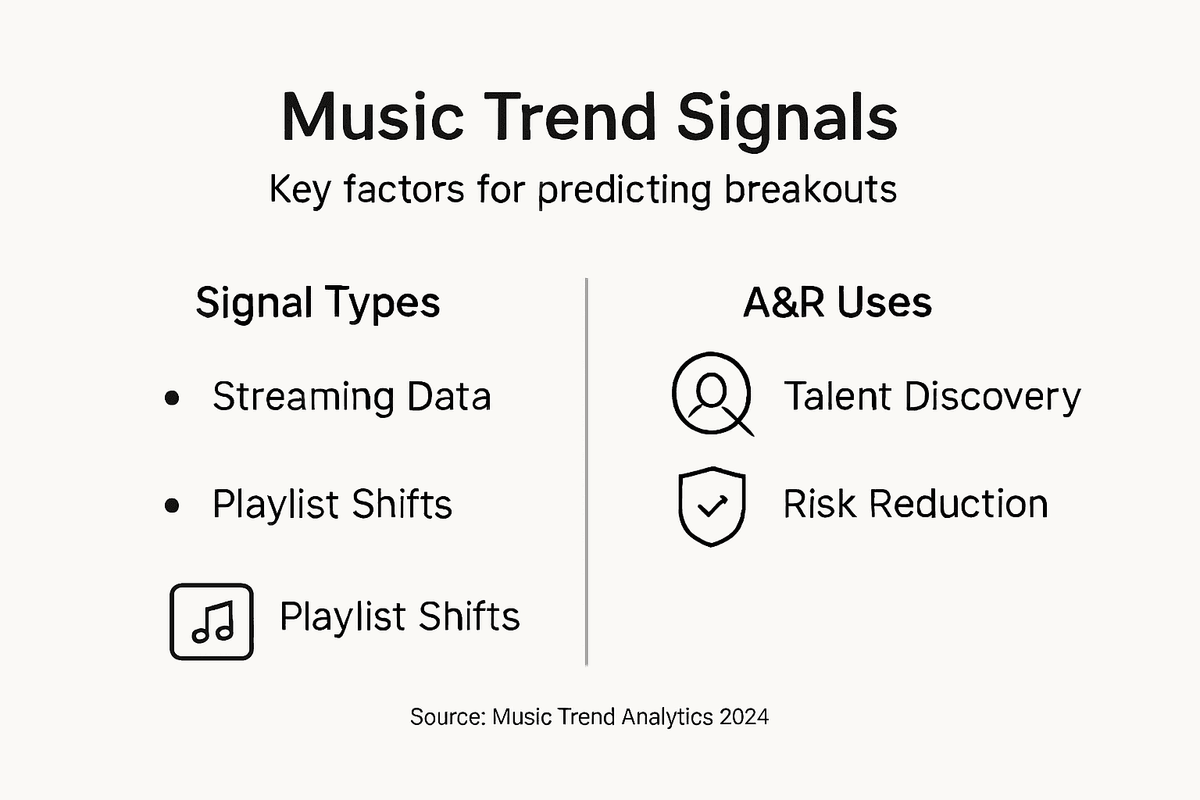
The following table summarizes how A&R teams benefit from trend signal analytics:
| Application Area | Benefit | Example Action |
|---|---|---|
| Artist Assessment | Reduces guesswork in scouting | Shortlists high-potential acts |
| Resource Allocation | Informs marketing investments | Targets specific audiences |
| Risk Management | Mitigates investment uncertainty | Optimizes tour planning |
| Career Development | Supports long-term growth | Maps tailored artist strategy |
Pro tip: Develop a multifaceted analytics dashboard that combines streaming data, social media metrics, playlist inclusions, and listener behavior to create a holistic artist potential score.
Ethical Risks and Data Privacy Concerns
The rapid evolution of music analytics introduces complex ethical challenges that demand careful navigation between technological innovation and fundamental human rights. Generative AI ethical risks in music production underscore the critical need for robust frameworks that protect individual privacy and creative integrity.
The primary ethical risks in music trend signal analytics include:
-
Privacy Invasion Risks
- Unauthorized data collection
- Potential user profiling
- Unintended personal information exposure
- Algorithmic surveillance concerns
-
Creative Authenticity Challenges
- Potential algorithmic bias
- Reduction of human creative agency
- Homogenization of musical expression
- Intellectual property complications
Technology platforms must implement comprehensive safeguards to mitigate these risks. AI applications in music production reveal nuanced challenges around transparency, fairness, and the fundamental right of individual musical creators to maintain control over their artistic representation.
The most responsible approach involves developing adaptive ethical guidelines that evolve alongside technological capabilities. This requires ongoing collaboration between technologists, musicians, legal experts, and privacy advocates to ensure that data-driven insights never compromise individual rights or artistic authenticity.
Pro tip: Implement strict anonymization protocols and obtain explicit consent mechanisms that provide musicians and listeners complete transparency about how their data will be utilized.
Unlock the Power of Music Trend Signals with Music24
The article highlights the challenge of identifying authentic emerging musical trends before they hit mainstream charts. Traditional analytics often rely on public metrics that overlook the nuanced, private playlist data where true listener preferences first emerge. If you want to move beyond surface-level insights and access detailed music trend signals like cultural context, listener engagement, and geographic micro-trends, you need a platform designed to analyze millions of anonymized private playlists. This approach reveals hidden artist discovery patterns and genre blending that remain invisible to most industry professionals.
Music24.com specializes in delivering predictive analytics rooted in private playlist data. Our platform empowers A&R teams, artist managers, and music marketers to detect breakout artists early, develop targeted marketing strategies, and make confident data-driven decisions. By tapping into unseen listener behaviors and influential curators, you gain a competitive edge in a rapidly evolving music landscape.
Take the first step toward discovering the next big breakout artist with insights unavailable anywhere else.

Explore how Music24 transforms music trend signal analysis into actionable opportunities. Visit our landing page now to unlock early artist discovery and start making smarter A&R decisions. Don't wait for trends to go public gain the advantage today.
Frequently Asked Questions
What are music trend signals?
Music trend signals are analytical frameworks that capture emerging patterns in listener behavior, genre evolution, and cultural musical preferences, helping industry professionals predict significant musical movements.
How can private playlist data reveal music trends?
Private playlist data offers insights into genuine listener preferences and hidden trend indicators, such as early artist discovery patterns and emerging genre crossovers, which traditional public metrics may not capture.
What role do technological innovation signals play in music analytics?
Technological innovation signals indicate changes in music production techniques and digital distribution patterns, helping professionals understand how new technology impacts music trends and listener engagement.
How can A&R professionals utilize music trend signals?
A&R professionals can leverage music trend signals to assess artist potential, allocate resources effectively, and make informed decisions by analyzing data on streaming behaviors, audience engagement, and emerging musical trends.
Recommended
- 7 Essential Music Industry Insights List for Spotting Trends - Blog - Music24.com
- 7 Micro-Trend Examples in Music Every A&R Should Know - Blog - Music24.com
- Music Trend Analysis: Early Artist Discovery Tactics - Blog - Music24.com
- Music Trend Spotting Checklist for Industry Pros - Blog - Music24.com

