
Private playlists signal emerging music trends before public charts and social media. For A&R teams and music executives, understanding how these hidden listener behaviors predict breakout artists can transform talent scouting and investment strategies. This guide explains how private playlist data offers earlier, more accurate signals than traditional metrics, and provides actionable techniques to apply these insights for competitive advantage in 2026.
Table of Contents
- Introduction To Private Playlist Data And Its Value
- Key Predictive Indicators In Private Playlist Data
- Common Misconceptions In Music Trend Prediction
- Analytic Techniques And Predictive Models For Trend Forecasting
- Practical Applications For A&R And Music Industry Executives
- Conclusion And Future Outlook
- Unlock Competitive Edge With Music24 Predictive Analytics
Key takeaways
| Point | Details |
|---|---|
| Early signals | Private playlists reveal authentic listener behavior earlier than public data, filtering promotional noise |
| Curator influence | Top 5% of private playlist curators drive over 40% of early trend signals, concentrating predictive power |
| Niche detection | Geographic micro-trends and genre fusion emerge in private data before mainstream discovery |
| Predictive accuracy | Machine learning models achieve 85% accuracy forecasting breakout artists 6-9 months ahead |
| A&R advantage | Data-driven teams increase signing success rates by 30% through early private playlist signals |
Introduction to private playlist data and its value
Private playlists are user-created music collections that remain unshared and invisible to the public. Unlike Spotify's viral charts or Instagram trending sounds, these personal libraries capture genuine listening preferences without promotional influence or social performance pressure. When aggregated and anonymized across millions of users, private playlist analytics reveal authentic patterns that public metrics consistently miss.
Public charts reflect mass popularity after extensive marketing campaigns. Social media virality often results from algorithmic manipulation or coordinated promotional pushes. Both lag behind actual listener discovery by weeks or months. Private playlists reflect authentic listener behavior that public metrics often miss, capturing the moment when early adopters first embrace new artists or genres.
This distinction matters because private playlists filter promotional noise. When someone adds a track to their personal workout or study playlist, they're making a genuine choice about what they want to hear repeatedly. No one adds music to private collections for social validation or trend participation. These decisions represent pure taste signals.
Key advantages of private playlist data include:
- Detection of organic discovery patterns before public chart impacts
- Identification of influential curators who drive early adoption
- Geographic mapping of regional micro-trends and genre preferences
- Genre fusion signals showing emerging cross-category innovations
- Sustained engagement metrics that distinguish lasting trends from viral flashes
Anonymized aggregation of millions of private playlists enables large-scale predictive analytics. Machine learning models can process these signals to forecast which artists will break out, which genres will surge, and which regional scenes will influence broader markets.
Key predictive indicators in private playlist data
Not all private playlists carry equal predictive weight. Understanding which signals matter most helps executives focus their analysis on the strongest trend indicators.
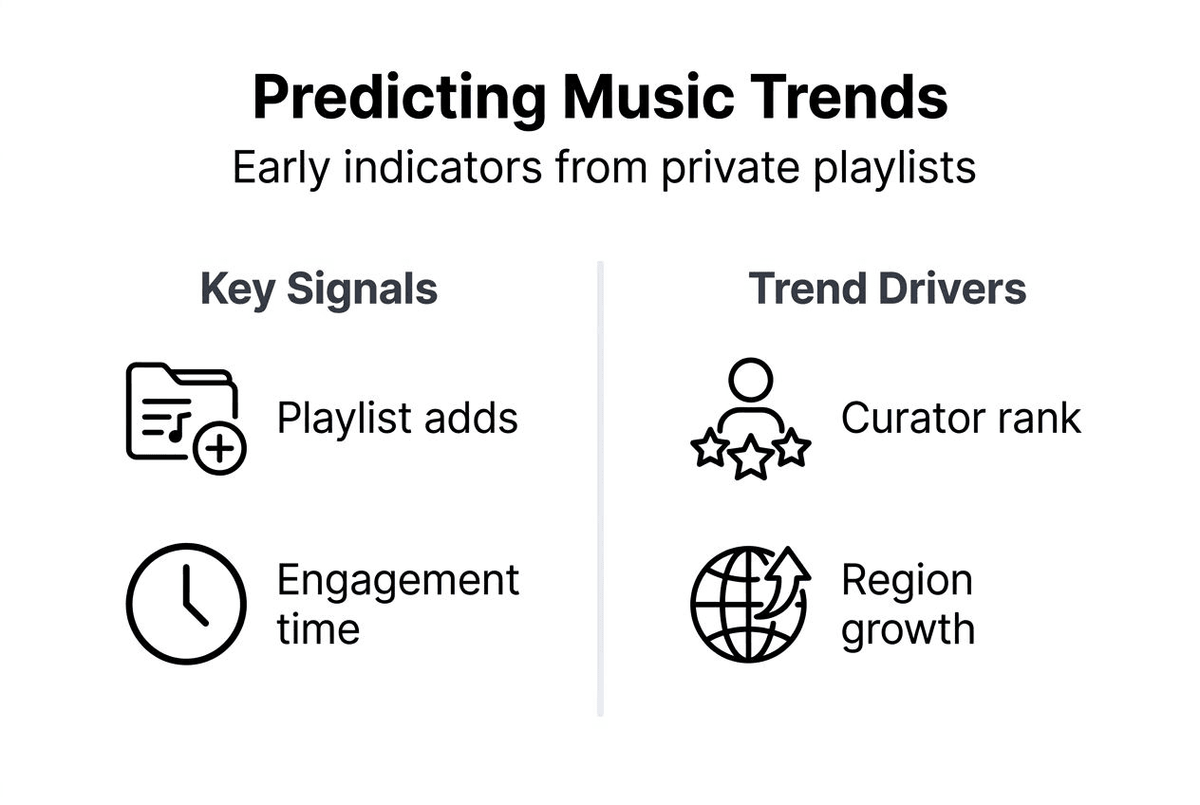
Curator influence concentrates heavily among elite tastemakers. Research shows that the top 5% of curators contribute over 40% of early music trend signals, creating a power law distribution. When these influential users add an emerging artist to multiple playlists, it predicts broader adoption with remarkable accuracy. Identifying and tracking these curators becomes essential for early warning systems.
Rapid playlist addition velocity signals breakout potential. When an artist accumulates private playlist adds at an accelerating rate, especially from diverse curator profiles, it indicates authentic grassroots momentum. This metric outperforms streaming counts because playlist addition requires active curation effort, not passive listening.

Sustained engagement within playlists confirms lasting appeal. Tracks that remain in private playlists for months demonstrate staying power beyond initial curiosity. This persistence separates genuine trends from temporary novelties that quickly fade from collections.
Genre blending patterns emerge clearly in music discovery private playlists. When users increasingly combine previously separate genres within single playlists, it signals fusion trends before they reach mainstream recognition. Using private playlist data enables discovery of niche genre pockets and cross-genre fusions often missed by public metrics.
Geographic micro-trends reveal regional preferences before national breakout. Analyzing where certain artists or genres concentrate in private playlists across cities and regions helps predict geographic expansion patterns. A Brooklyn-centered trend today may signal a nationwide movement in six months.
Pro Tip: Track not just which artists appear in private playlists, but their playlist context. An emerging artist consistently placed alongside established stars in specific genres signals perceived quality alignment and likely audience crossover.
These indicators work best in combination. When top music analytics metrics show simultaneous signals across curator influence, addition velocity, genre fusion, and geographic concentration, predictive confidence reaches its peak.
Common misconceptions in music trend prediction
Several persistent myths prevent executives from leveraging data-driven trend prediction effectively. Recognizing these misconceptions helps teams avoid costly strategic errors.
-
Social media virality guarantees sustainable success. Many executives assume viral TikTok moments or Instagram trending sounds automatically translate to lasting artist careers. Reality tells a different story. Over 50% of viral social hits lose private playlist engagement within a month, showing that social media virality often doesn't signal lasting trends. Viral moments create awareness but rarely indicate genuine listener affinity.
-
Public streaming data reflects true organic discovery. Streaming platforms count every play equally, whether from algorithmic recommendations, playlist placements purchased through promotional services, or genuine fan replays. This creates a distorted picture heavily influenced by marketing spend. Private playlist data cuts through this noise by measuring intentional curation decisions that reflect actual listener preferences.
-
Trend prediction remains inherently subjective guesswork. Traditional A&R relied heavily on gut instinct and industry connections. While experience matters, treating trend forecasting as purely intuitive ignores the predictive power of machine learning applied to private playlist patterns. Algorithms can process millions of signals humans cannot track manually, achieving playlist data interpretation accuracy that exceeds individual judgment.
"The biggest mistake executives make is confusing promotional success with authentic discovery. Private playlist data separates genuine trends from manufactured hype, giving A&R teams the early signals they need to make confident investment decisions."
These misconceptions stem from decades of relying on public metrics because private data remained inaccessible. Now that anonymized private playlist analytics exist, continuing to base strategies on lagging public indicators means operating with incomplete intelligence while competitors gain predictive advantages.
Analytic techniques and predictive models for trend forecasting
Converting private playlist data into actionable forecasts requires sophisticated machine learning models and analytic frameworks. Understanding these techniques helps executives evaluate platform capabilities and trust prediction outputs.
Anonymized data processing begins by aggregating millions of private playlists while protecting individual user privacy. Machine learning algorithms identify patterns across this massive dataset, detecting correlations between early playlist behaviors and subsequent mainstream success. These models continuously learn and refine predictions as new data flows in.
Predictive accuracy reaches approximately 85% for breakout artist detection when using comprehensive private playlist signals. This performance far exceeds traditional methods relying on public charts or social metrics alone. Models achieve this accuracy by weighing multiple factors simultaneously: curator influence scores, addition velocity, genre context, geographic concentration, and engagement persistence.
Forecast time horizons typically extend 6 to 9 months ahead of public chart impacts. This lead time proves invaluable for A&R strategy because it enables proactive signing, marketing planning, and resource allocation before competition intensifies. Executives can position themselves strategically rather than reacting to already-established trends.
Key algorithmic approaches include:
- Collaborative filtering to identify taste clusters and cross-audience potential
- Time-series analysis to detect acceleration patterns in playlist additions
- Network analysis to map curator influence propagation through tastemaker networks
- Natural language processing to analyze playlist titles and descriptions for genre fusion signals
- Geographic clustering to identify regional micro-trends and expansion patterns
| Model Type | Predictive Focus | Accuracy Range | Lead Time |
|---|---|---|---|
| Curator Network Analysis | Influence propagation | 82-88% | 6-8 months |
| Addition Velocity Tracking | Breakout timing | 78-85% | 4-7 months |
| Genre Fusion Detection | Emerging categories | 75-82% | 7-10 months |
| Geographic Clustering | Regional trends | 80-86% | 5-9 months |
Pro Tip: Demand transparency about model training data and validation methods when evaluating analytics platforms. Models trained on public data alone cannot reliably predict private playlist behaviors, limiting their early detection capabilities.
The most powerful predictions emerge from ensemble models combining multiple algorithmic approaches. When network analysis, velocity tracking, and geographic clustering all signal the same emerging artist, confidence in that prediction increases substantially.
Practical applications for A&R and music industry executives
Private playlist insights translate into concrete competitive advantages across talent scouting, marketing strategy, and investment decisions. Executives who implement these applications systematically outperform competitors still relying on traditional methods.
Early breakout signals increase signing success rates dramatically. Data-driven A&R teams achieve 30% higher breakout artist signing success rates by identifying talent before bidding wars inflate costs. When private playlist data flags an artist with strong curator adoption and accelerating additions, executives can initiate conversations while the artist remains undiscovered by mainstream labels.
Geographic micro-trends enable targeted regional marketing. Detecting that an artist shows strong private playlist concentration in specific cities allows labels to focus promotional resources efficiently. Launch touring in high-affinity markets first, building momentum that naturally expands to adjacent regions identified through data.
Niche genre investment becomes less risky when backed by private playlist validation. Instead of guessing which experimental sounds might find audiences, executives can follow data-driven artist discovery tips showing actual listener adoption patterns. This evidence-based approach reduces costly failed bets on genres without market fit.
Marketing strategy agility improves through continuous trend monitoring. Rather than locking into annual plans, teams can track shifting private playlist patterns monthly or weekly. When data shows a genre fusion trend accelerating faster than expected, marketing budgets can pivot to capitalize on the moment.
Key implementation practices include:
- Integrate private playlist analytics into regular A&R review meetings
- Establish curator influence thresholds that trigger deeper artist evaluation
- Map your current roster against emerging genre trends to identify positioning opportunities
- Create geographic expansion playbooks based on private playlist concentration data
- Develop automated alerts when artists meet defined breakout signal criteria
Executives should also leverage artist discovery checklist frameworks that systematically incorporate private playlist metrics alongside traditional evaluation criteria. This structured approach prevents overlooking key signals during high-volume scouting.
The competitive advantage compounds over time. Each successful early signing based on private playlist data builds organizational confidence in the methodology. Teams develop pattern recognition skills that complement algorithmic predictions, creating a powerful human-machine collaboration.
Conclusion and future outlook
Private playlist data fundamentally changes how music industry executives identify emerging trends and discover breakout artists. By revealing authentic listener behaviors before public metrics reflect them, these insights provide 6 to 9 month predictive lead times that translate into substantial competitive advantages.
The key benefits center on accuracy, timing, and strategic focus. Achieving 85% prediction accuracy with half-year advance notice allows proactive positioning rather than reactive scrambling. Identifying influential curators, geographic micro-trends, and genre fusion patterns creates multiple pathways to early discovery. Most importantly, filtering promotional noise from genuine listener affinity prevents costly mistakes chasing manufactured virality.
Looking ahead to 2026 and beyond, predictive analytics will become table stakes for competitive A&R operations. Labels and executives who adopt data-driven approaches now establish institutional capabilities that competitors will struggle to replicate. The music industry is shifting from instinct-based talent scouting to evidence-based discovery powered by private playlist intelligence.
Executives face a clear choice: continue relying on lagging public metrics while competitors gain early-mover advantages, or embrace private playlist analytics to transform scouting effectiveness. The tools exist. The predictive accuracy is proven. The only question is whether you'll leverage these insights before your competition does.
Unlock competitive edge with Music24 predictive analytics
Transforming private playlist insights into strategic advantages requires the right analytics platform. Music24 specializes in exactly this challenge, providing music industry executives with advanced tools that detect emerging trends months before mainstream recognition.
Our proprietary analytics process millions of anonymized private playlists to identify breakout artists, influential curators, genre fusion patterns, and geographic micro-trends with industry-leading accuracy. A&R teams using Music24 predictive analytics platform gain the early signals needed to make confident signing decisions, allocate marketing resources efficiently, and stay ahead of rapidly shifting listener preferences. Discover how data-driven discovery can elevate your competitive position.
FAQ
What is private playlist data and why does it matter?
Private playlists are user-created music collections that remain unshared and hidden from public view. They matter because they capture authentic listening preferences without promotional influence or social validation pressure. When aggregated anonymously across millions of users, these genuine taste signals predict emerging trends before public charts or social metrics reflect them.
How do private playlists outperform public metrics for trend spotting?
Private playlists show organic listener behavior unaffected by marketing campaigns or algorithmic manipulation. Top curators within private playlist networks concentrate trend influence, creating clear early signals when they adopt new artists. This removes the promotional noise that distorts public streaming counts and social media metrics.
What are common mistakes when predicting music trends?
The biggest mistakes include overrelying on social media virality that often fades within weeks, treating public streaming data as purely organic when it reflects heavy promotional influence, and approaching trend prediction as subjective guesswork rather than data-driven science. Many executives also ignore curator influence patterns and geographic micro-trends that provide the strongest early signals.
How can A&R teams apply private playlist analytics successfully?
Use early breakout signals showing strong curator adoption and addition velocity to focus scouting efforts before competition intensifies. Leverage geographic concentration patterns to design data-driven artist discovery tips and targeted regional marketing campaigns. Invest confidently in niche genres when private playlist data validates authentic listener demand, reducing risky bets on unproven sounds.

