
Most A&R teams believe streaming volume alone reveals emerging artist potential. That's a costly misconception. Over 60% of new artist discoveries happen outside public channels using private playlist data before charts reflect them. Mastering specialized data terminology unlocks competitive advantages in talent scouting, enabling you to identify breakout artists months ahead of the competition.
Table of Contents
- Introduction To Music Industry Data Terminology
- Core Music Data Terminology And Concepts
- Private Playlist Analytics: What Sets It Apart
- How Curator Influence Shapes Artist Discovery
- Common Pitfalls In Interpreting Music Industry Metrics
- Applying Data Terminology To A&R Decision Making
- Conclusion: Transforming A&R With Music Data Mastery
- Explore Music Analytics Tools To Master Early Discovery
Key takeaways
| Point | Details |
|---|---|
| Private playlist data reveals emerging artists up to months earlier than public metrics | Analyzing private collections captures authentic listener preferences before mainstream awareness |
| Understanding metadata, streaming metrics, and curator influence is critical to accurate discovery | Precise terminology interpretation prevents misreading data signals and missed opportunities |
| Misinterpreting raw streaming volume leads to missed opportunities; engagement metrics matter more | High play counts without playlist penetration or engagement context provide incomplete artist potential assessment |
| Curator authority within private playlists amplifies authentic music trends | Consistent, high-engagement curators signal genuine breakout potential better than public charts |
| Applying data insights strategically enhances marketing ROI and signing success | Geographic and genre micro-trends enable targeted campaigns that maximize investment returns |
Introduction to music industry data terminology
Music data has transformed from a supplementary tool into the core foundation of modern A&R workflows. Record labels no longer rely solely on radio play, social buzz, or gut instinct to identify talent. Instead, they leverage sophisticated music data terminology to decode listener behavior, predict breakout potential, and allocate marketing budgets efficiently.
The shift from traditional discovery to digital playlist analytics represents a fundamental change in how the industry operates. Radio spins and physical sales once dominated talent scouting metrics. Today, streaming platforms and playlist ecosystems generate vast amounts of behavioral data that reveal authentic listener preferences in real time.
Private playlist data stands at the forefront of this transformation. Unlike public charts or social metrics, which reflect what listeners share outwardly, private playlists capture genuine musical taste without performative bias. This distinction matters because:
- Private collections reveal unfiltered listening habits and emerging preferences
- Early playlist adoption signals authentic interest before viral trends emerge
- Geographic and genre patterns surface micro-trends invisible in aggregated public data
- Curator influence within private ecosystems amplifies niche artists organically
Mastering the terminology that defines these data points empowers A&R teams to interpret signals accurately, avoid costly misreadings, and secure talent ahead of competitors who rely on lagging public indicators.
Core music data terminology and concepts
Understanding essential music data terms forms the foundation for interpreting analytics effectively. These concepts enable you to assess artist potential, track engagement patterns, and identify emerging trends with precision.
Streaming metrics measure listener interaction across platforms. Key terms include:
- Streaming volume: Total play counts across all platforms and time periods
- Playlist penetration: Percentage of relevant playlists featuring a specific track, indicating reach depth
- Engagement rates: Metrics like save rates, repeat listens, and skip rates that reveal listener commitment
- Listener retention: How long users stay engaged with a track before skipping or moving on
Metadata plays a critical role in accurate discovery, rights management, and royalty distribution. Metadata components include artist information, ISRC codes, genre classification, release dates, and production credits. Accurate metadata ensures tracks surface in appropriate discovery contexts and reach intended audiences.
Acoustic features profile tracks using quantifiable musical characteristics. These include tempo (BPM), key signature, energy levels, danceability scores, and vocal prominence. DSP algorithms use metadata and listener interaction from playlists to personalize recommendations and affect artist visibility. Understanding acoustic features helps predict which tracks fit emerging listener preferences and genre-blending trends.
Genre crossover indices measure how tracks blend or transcend traditional genre boundaries. High crossover scores indicate songs appealing to multiple listener segments, often signaling breakout potential beyond niche audiences.
Pro Tip: Always cross-reference streaming volume with engagement rates. A track with 100,000 streams but a 70% skip rate signals shallow interest, while 20,000 streams with 80% save rates indicates strong authentic demand worth investigating for music data terminology for A&R purposes.
| Metric Type | Definition | Strategic Value |
|---|---|---|
| Streaming Volume | Total play counts | Baseline awareness indicator |
| Playlist Penetration | Share of relevant playlists including track | Depth of reach and curator interest |
| Engagement Rate | Saves, repeats, low skips | Authentic listener commitment |
| Curator Consistency | Thematic alignment in curator's playlists | Reliability of trend signal |
| Genre Crossover Index | Multi-genre appeal score | Breakout potential beyond niche |
Refer to a comprehensive music industry glossary to deepen your understanding of these foundational terms and their applications in talent evaluation.
Private playlist analytics: what sets it apart
Private playlist data offers unique advantages over public streaming metrics. Public data reflects aggregated, visible behavior such as chart positions, viral social shares, and official playlist placements. These indicators lag behind actual listener discovery because they measure popularity after it has already formed.

Private playlists capture authentic listener preferences without the influence of social performance or algorithmic manipulation. Users curate personal collections based on genuine taste, creating unfiltered snapshots of emerging musical trends. This authenticity matters because it reveals what listeners truly enjoy, not what they publicly endorse for social validation.
Geographic micro-trends surface clearly in private playlist data. A track gaining traction in Austin private playlists months before Nashville or Los Angeles adoption signals regional breakout potential. These geographic patterns enable targeted regional marketing campaigns, festival bookings, and tour routing that maximize ROI by focusing efforts where organic interest already exists.
Private playlist analytics enable identification of emerging artists up to several months before public chart appearances. This lead-time advantage allows A&R teams to sign talent before bidding wars inflate costs and negotiate more favorable terms with artists who have yet to achieve mainstream recognition.
Pro Tip: Monitor private playlist adds in the first 14 days after a track release. Rapid private adoption with low public visibility indicates authentic grassroots interest that often precedes viral breakout by 8 to 12 weeks, giving you a critical window to act before competitors notice.
| Data Source | Strengths | Limitations |
|---|---|---|
| Public Streaming Metrics | Broad visibility, easy to track, industry standard benchmarks | Lags behind actual discovery, influenced by paid promotion |
| Private Playlist Data | Early detection, authentic preferences, geographic micro-trends | Requires specialized access, smaller sample size |
| Social Media Metrics | Viral trend identification, audience sentiment | Performative bias, short-lived trends, bot inflation |
| Radio Airplay | Traditional reach indicator | Declining relevance, slow adoption, gatekeeping bias |
Explore more about private playlist analytics workflow to implement these insights systematically. For deeper context, review understanding private playlist data to grasp the full scope of this transformative approach.
How curator influence shapes artist discovery
Playlist curators function as tastemakers within private ecosystems, amplifying emerging artists through their personal collections. Unlike algorithm-driven official playlists, individual curators bring thematic consistency and specialized genre expertise that attract engaged follower communities.
Curator thematic consistency measures how reliably a curator's playlist selections align with specific genres, moods, or artist profiles. High consistency indicates deep genre knowledge and cultivated taste, making their selections more trustworthy signals of authentic quality. Engagement metrics around curator playlists such as follower counts, playlist saves, and listener interaction rates quantify their influence reach.
Curators amplify niche and micro-trends authentically by championing under-recognized artists before mainstream platforms feature them. A curator with 5,000 engaged followers in the indie electronic space holds more predictive power for that genre than a generic pop playlist with 500,000 passive followers. Their endorsement signals genuine quality within a targeted listener community.
Measuring curator authority requires analyzing multiple dimensions:
- Follower count and growth trajectory over time
- Average engagement rates per playlist track
- Thematic consistency across playlist updates
- Historical track record of featuring artists who later broke out
- Geographic concentration or diversity of follower base
Not all curators have equal impact on discovery. A curator who frequently updates playlists with emerging artists and maintains high engagement signals active tastemaking. Conversely, curators who rarely update or feature only established acts provide limited predictive value for early artist detection. Learn more about the role of curators in music discovery and how curator influence data discovery transforms A&R workflows.
Common pitfalls in interpreting music industry metrics
Relying solely on raw streaming volume without engagement context leads to costly misjudgments. A track with 500,000 streams might appear promising until you examine a 65% skip rate and low playlist penetration, revealing shallow algorithmic placement rather than authentic listener interest. Always pair streaming counts with engagement metrics to assess true artist potential.
Misreading public data as fully representative overlooks the critical insights private playlist data provides. Public charts reflect what has already gained mainstream traction, not what is emerging. By the time a track charts publicly, signing costs increase and competitive bidding begins. Ignoring private data means you consistently arrive late to talent opportunities.
Ignoring curator influence metrics strips away the social amplification layer that drives authentic trends. A track added to 200 private playlists curated by engaged tastemakers signals stronger breakout potential than 2,000 adds to algorithmically generated or inactive playlists. Curator quality matters more than quantity.
Misinterpreting genre crossover data can lead to misaligned marketing strategies. A track scoring high on genre crossover might appeal broadly or lack distinct identity, depending on context. Examine which specific genres blend and whether the crossover represents innovative fusion or diluted positioning. Strategic interpretation requires understanding the nuance behind the numbers.
Pro Tip: Create a weighted scoring model that combines streaming volume, engagement rates, playlist penetration, and curator influence. Assign higher weights to engagement and curator metrics than raw volume to prioritize authentic interest over algorithmic noise. This approach surfaces genuine breakout candidates more reliably.
Additional common mistakes include:
- Treating all playlist adds equally without differentiating private, official, and algorithmic placements
- Overlooking geographic concentration patterns that signal regional breakout potential
- Failing to track velocity metrics such as week-over-week growth in private adds
- Ignoring seasonal trends that affect genre popularity and listener behavior
Understand these music data pitfalls thoroughly to avoid undermining your competitive advantage through preventable analytical errors.
Applying data terminology to A&R decision making
Integrating data terminology into talent scouting requires structured frameworks that translate insights into actionable decisions. Follow this step-by-step approach to interpret playlist and streaming data effectively:
- Establish baseline metrics for your target genre or market segment, including average streaming volume, typical engagement rates, and standard playlist penetration benchmarks.
- Identify outliers that exceed baseline metrics in engagement rates and private playlist penetration while maintaining moderate streaming volume, signaling early-stage authentic interest.
- Analyze curator profiles adding the track to assess thematic consistency, follower engagement, and historical breakout prediction accuracy.
- Map geographic concentration to identify regional micro-trends and plan targeted marketing campaigns, tour routing, and local media outreach.
- Monitor velocity trends by tracking week-over-week changes in private playlist adds, engagement rates, and geographic expansion to assess momentum sustainability.
- Cross-reference acoustic features with emerging genre trends to predict broader market appeal and identify strategic positioning opportunities.
Case studies illustrate how private playlist data enables early detection. An indie pop artist gained 800 private playlist adds in Austin and Portland within three weeks of release, with 75% save rates and minimal public chart presence. A&R teams monitoring private data signed the artist two months before a viral TikTok moment drove mainstream awareness, securing favorable contract terms and early marketing positioning.
Another example involves a Latin trap artist whose tracks showed high genre crossover scores between reggaeton and hip-hop in Miami private playlists. Effective use of geographic and genre micro-trends improves marketing ROI and signings. The label launched a bilingual campaign targeting both markets simultaneously, resulting in crossover chart success and expanded audience reach.
Strategically leverage geographic and genre insights by aligning marketing spend with proven organic interest zones. If private data shows concentration in Seattle and Chicago, prioritize radio promotion, influencer partnerships, and live events in those cities rather than spreading budgets thinly across national campaigns.
Encourage data-driven workflows by integrating private playlist analytics into weekly A&R reviews, artist evaluation scorecards, and signing decision frameworks. Use the artist discovery checklist and rising artist discovery workflow to systematize these practices. For additional depth, explore mastering music industry data analytics to refine your analytical approach.
Conclusion: transforming A&R with music data mastery
Private playlist data has fundamentally transformed early artist discovery by providing authentic, unfiltered insights into listener preferences months before public metrics reflect emerging trends. Mastering industry data terminology empowers you to interpret these signals accurately, avoid costly misreadings, and secure talent ahead of competitors who rely on lagging indicators.
The strategic advantage lies not in collecting more data but in understanding the precise terminology that defines meaningful patterns within that data. Streaming volume, playlist penetration, curator influence, engagement rates, and genre crossover indices each tell part of the story. Together, they form a comprehensive picture of artist potential and market readiness.
Integrate these insights into your A&R and marketing workflows to stay ahead in the rapidly evolving music industry landscape. The teams that master private playlist data terminology today will dominate talent acquisition and market positioning throughout 2026 and beyond.
Explore music analytics tools to master early discovery
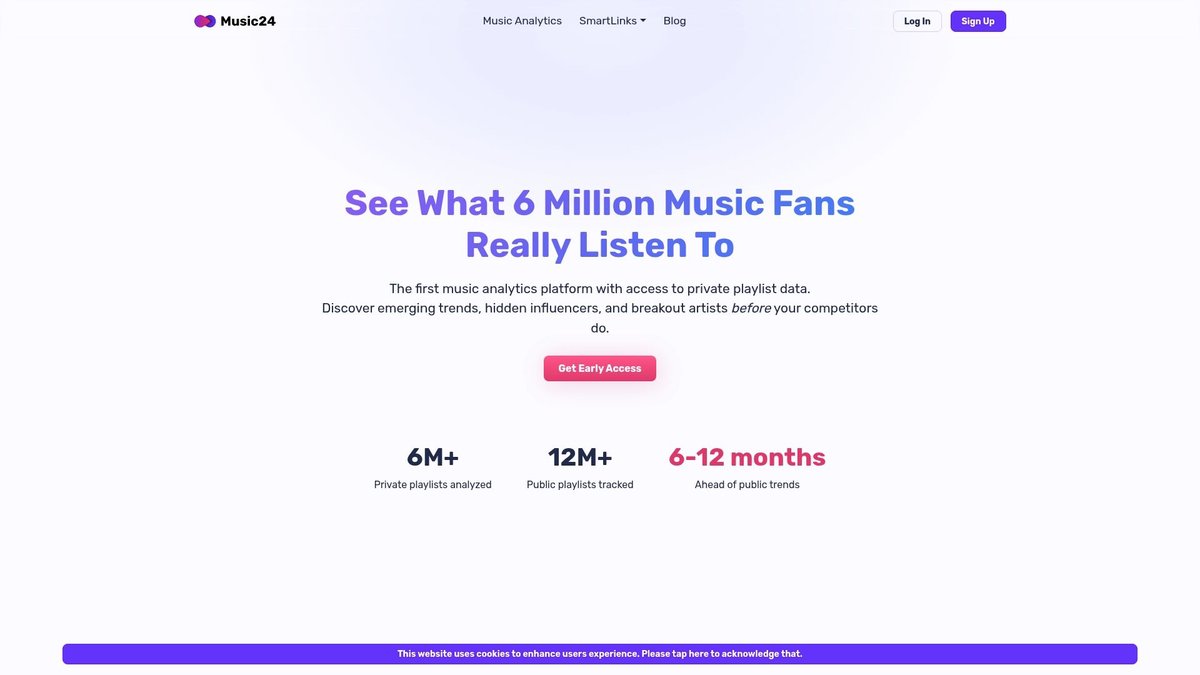
Ready to leverage private playlist data for competitive advantage? Music24 offers specialized music analytics tools designed to surface emerging artists before public charts reflect their potential. Our platform transforms complex data into actionable insights, enabling you to identify breakout talent months ahead of the competition.
Explore how music marketing analytics enhance discovery precision by combining streaming metrics, curator influence data, and geographic micro-trends into unified intelligence dashboards. Our private playlist analysis guide walks you through systematic workflows for integrating these insights into daily A&R operations, maximizing your signing success and marketing ROI.
FAQ
What is playlist penetration and why does it matter?
Playlist penetration measures the share of relevant playlists that include a specific track, indicating reach depth and curator interest level. High penetration across private playlists signals authentic listener engagement before public awareness builds. This metric helps A&R teams distinguish between tracks gaining organic traction versus those relying solely on algorithmic placement or paid promotion.
How can A&R teams differentiate curator influence in data?
Curator influence is measured by consistency, engagement, and playlist reach metrics. Focus on curators who maintain thematic expertise, update playlists frequently, and demonstrate historical accuracy in featuring artists who later broke out. A curator with 5,000 engaged followers in a niche genre provides stronger signals than generic playlists with passive audiences. Learn more about how to understand curator influence systematically.
What common mistakes should be avoided in music data analysis?
Overemphasis on raw streaming counts without engagement context leads to misidentifying shallow algorithmic plays as genuine interest. Ignoring curator influence and genre crossover data strips away critical signals of authentic breakout potential. Neglecting private playlist insights means consistently arriving late to talent opportunities after competitors have already initiated signing discussions. Avoid these common music data mistakes to maintain competitive advantage.
How early can private playlist data predict artist breakout?
Private playlist analytics typically identify emerging artists two to four months before public chart appearances or viral social moments. Tracks showing rapid private playlist adoption with high engagement rates and strong curator interest signal imminent breakout potential. This lead time enables A&R teams to initiate contact, negotiate favorable terms, and position marketing strategies before mainstream awareness drives up signing costs and competition intensity.
Recommended
- Music Industry Analytics: Unlocking Early Artist Discovery - Blog - Music24.com
- Music Industry Data: Unlocking Hidden Trends Early - Blog - Music24.com
- Music Marketing Analytics: Unlocking Early Artist Discovery - Blog - Music24.com
- Music Discovery Lifecycle: Transforming Artist Breakouts - Blog - Music24.com

