
Many music professionals assume Spotify's private playlists remain completely invisible to outsiders, protected by ironclad privacy settings. This misconception can derail talent discovery strategies and marketing campaigns built on incomplete data understanding. In reality, private playlists are accessible via direct URLs, creating nuanced visibility that contradicts their privacy label. For A&R teams, artist managers, and marketing strategists navigating the 2026 music landscape, understanding the true accessibility and limitations of private versus public playlist data is essential for building competitive intelligence frameworks and identifying emerging trends before they surface on mainstream charts.
Table of Contents
- Understanding Spotify's Private Vs Public Playlists: What Data Really Means
- The 2026 Spotify API Changes And Their Impact On Private Playlist Data Access
- Comparing Private And Public Playlist Data: Visibility, Access, And Usage
- Leveraging Private Playlist Data For Talent Discovery And Trend Analysis
- Explore More Insights And Tools At Music24
- Frequently Asked Questions About Private Vs Public Playlist Data
Key takeaways
| Point | Details |
|---|---|
| Private playlist accessibility | Spotify private playlists can be accessed via direct URLs despite privacy settings, creating unexpected visibility for shared links. |
| 2026 API restrictions | February 2026 updates require 250,000 monthly active users for Extended Quota Mode, severely limiting independent developer access to playlist metadata. |
| Data visibility differences | Public playlists appear in search results and discovery feeds, while private playlists remain hidden from search but accessible through URL sharing. |
| Strategic applications | Music professionals can leverage aggregate demographic trends and URL-based monitoring to identify rising artists and micro-trends in private collections. |
Understanding Spotify's private vs public playlists: what data really means
Spotify defines public playlists as discoverable collections that appear in search results, user profiles, and algorithmic recommendations across the platform. These playlists contribute to artist visibility metrics and can be followed by any Spotify user browsing the ecosystem. Public playlists serve as social signals, broadcasting curator taste and potentially influencing streaming algorithms that power Discover Weekly and Release Radar features.
Private playlists, by contrast, are excluded from Spotify's search index and do not appear on user profiles or in discovery feeds. However, the critical nuance that many industry professionals miss is that private playlists remain accessible via direct URLs, meaning anyone with the link can view the full track listing and curator information. This accessibility creates a gray zone where privacy settings provide search protection but not absolute invisibility.
The Spotify API historically allowed developers to retrieve metadata from playlists if they possessed valid authentication tokens and playlist IDs. This technical capability meant that private playlists, while hidden from casual browsing, could theoretically be analyzed by third-party applications with proper API credentials. The distinction between search invisibility and technical accessibility has profound implications for understanding private playlist data and its role in competitive music intelligence.
Industry professionals often operate under three common misconceptions:
- Private playlists are completely inaccessible to anyone except the creator
- Spotify's API provides unlimited access to all playlist metadata regardless of privacy settings
- Public playlists are the only relevant data source for trend analysis and artist discovery
These assumptions lead to flawed data strategies that either overestimate privacy protections or undervalue the intelligence embedded in private collections. The reality is that private playlists represent authentic listening behavior unconstrained by social performance, making them valuable indicators of genuine music preferences when accessible through legitimate channels.
Pro Tip: When analyzing playlist data for artist discovery, prioritize collections with 50+ tracks and regular update patterns, as these indicate engaged curators whose taste profiles can predict emerging trends more reliably than one-off compilations.
The 2026 Spotify API changes and their impact on private playlist data access
In February 2026, Spotify implemented sweeping API access restrictions that fundamentally altered how independent developers and music analytics platforms retrieve playlist data. The changes introduced two operational tiers: Development Mode and Extended Quota Mode. Development Mode now limits applications to 25 authorized users and restricts data retrieval to basic metadata, effectively eliminating commercial viability for startups and independent analytics tools.
Extended Quota Mode, which provides access to deeper playlist metadata and larger user bases, requires applications to demonstrate 250,000 monthly active users before approval. This threshold creates a paradoxical barrier where emerging platforms need substantial user data to qualify for the API access necessary to build those user bases in the first place. The API lockdown removes key data points that independent developers previously used to offer competitive intelligence services to record labels and artist management teams.
The practical implications for music professionals are significant:
- Third-party analytics platforms must now operate with severely constrained data access unless they achieve massive scale
- Independent A&R tools that previously offered real-time playlist monitoring face operational challenges or shutdown
- Manual playlist tracking via URL sharing becomes more valuable as automated API-based solutions decline
- Established platforms with existing user bases gain competitive advantages over new market entrants
- Music professionals must increasingly rely on Spotify's first-party analytics tools like Spotify for Artists rather than independent alternatives
The approval process for Extended Quota Mode involves manual review by Spotify's developer relations team, with emphasis on data security protocols, privacy compliance, and legitimate business use cases. Applications must demonstrate clear value propositions that align with Spotify's platform integrity goals while proving technical capability to handle large-scale data operations responsibly.
For startups building tools around private playlist data, the 2026 changes represent an existential challenge. The most viable path forward involves partnering with established platforms that already possess Extended Quota Mode access or pivoting to data collection methodologies that don't rely on Spotify's API, such as user-permissioned data sharing or aggregate trend reporting from consenting playlist creators.
Pro Tip: Music professionals evaluating analytics vendors should verify their API access tier and data collection methodologies, as many tools marketed in 2026 may be operating with Development Mode limitations that constrain data freshness and sample sizes below useful thresholds.
Comparing private and public playlist data: visibility, access, and usage
The fundamental distinction between private and public playlist data extends beyond simple visibility settings to encompass discoverability, audience insights, and strategic applications for music marketing. Public playlists function as social objects that contribute to Spotify's recommendation algorithms, appear in genre-specific browse categories, and can be embedded on external websites. This visibility makes public playlists valuable for gauging mainstream adoption and measuring the reach of playlist pitching campaigns.
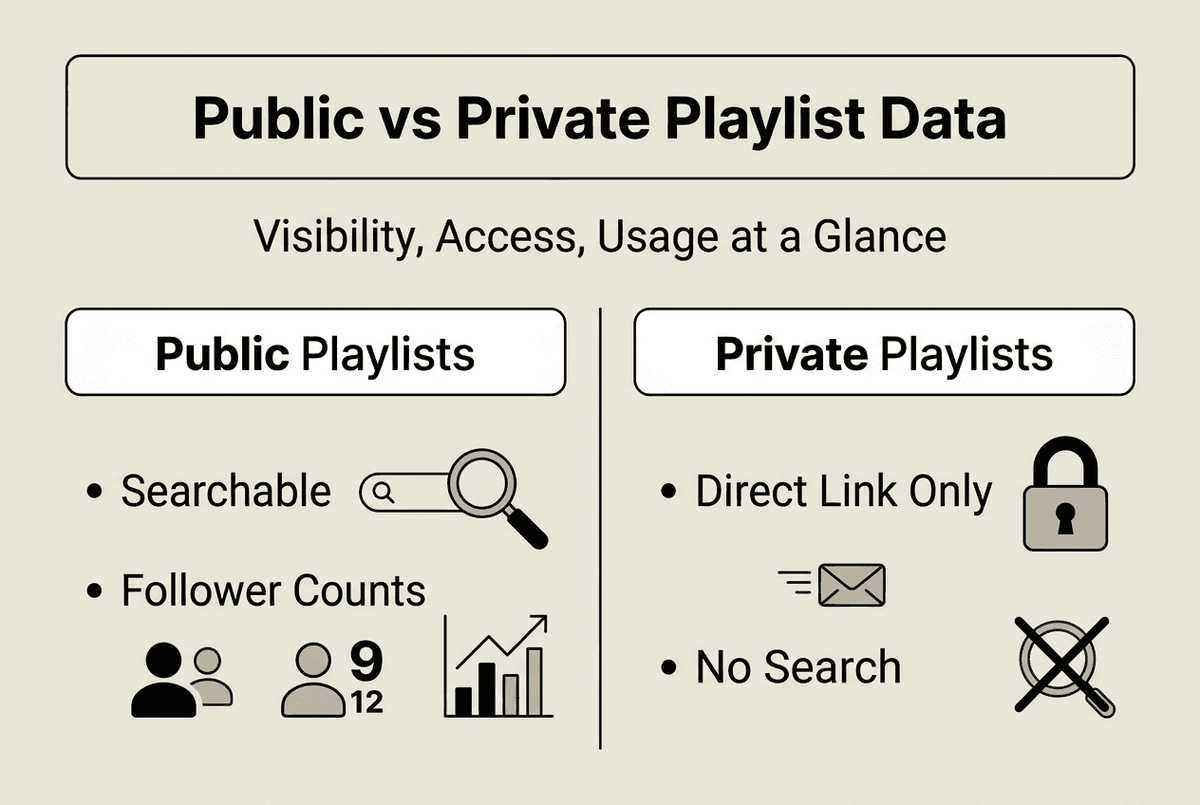
Private playlists, while excluded from search and discovery features, offer a window into unfiltered listening preferences. Users creating private collections are less influenced by social signaling and more likely to include guilty pleasures, experimental tracks, and emerging artists they're genuinely curious about but not ready to publicly endorse. This behavioral difference makes private playlist data particularly valuable for identifying authentic discovery patterns that precede public chart performance.

The following table illustrates key differences:
| Feature | Public Playlists | Private Playlists |
|---|---|---|
| Search visibility | Appear in Spotify search results | Hidden from all search functions |
| Profile display | Visible on creator profiles | Not displayed on profiles |
| URL accessibility | Accessible and shareable | Accessible via direct URL only |
| Algorithmic influence | Contribute to recommendation systems | Minimal algorithmic impact |
| Social signaling | High social performance factor | Authentic preference indicator |
| API accessibility (2026) | Limited metadata via approved apps | Severely restricted access |
Spotify's internal analytics dashboards track near real-time listener behavior across both playlist types, aggregating individual listening data into demographic trends and genre affinity patterns. However, this granular data remains proprietary to Spotify and select major label partners with data-sharing agreements. Independent music professionals must work with aggregate insights and trend signals rather than individual listener identification.
Strategic applications differ significantly between playlist types:
- Public playlists excel for measuring campaign reach, tracking playlist placement ROI, and identifying influential curators with large follower bases
- Private playlists provide early signals of emerging artist interest, genre-blending trends, and authentic discovery patterns unconstrained by social pressure
- Combined analysis of both types creates a comprehensive view of artist trajectory, from private early adopters to public mainstream acceptance
For A&R teams evaluating new talent, monitoring private playlist additions via URL sharing networks can reveal genuine industry buzz before public metrics reflect interest. Artist managers can use public playlist growth to demonstrate marketability to booking agents and festival promoters, while using private playlist insights to identify geographic micro-markets and demographic niches worth targeting with focused campaigns.
Pro Tip: Track the ratio of private to public playlist adds for emerging artists as a leading indicator of organic discovery versus manufactured hype, with higher private-to-public ratios suggesting authentic grassroots interest.
Leveraging private playlist data for talent discovery and trend analysis
Music professionals can extract actionable intelligence from private playlist data despite API restrictions by implementing strategic monitoring frameworks and leveraging aggregate trend signals. The key is shifting from comprehensive data collection to targeted intelligence gathering focused on high-value curator networks and emerging trend indicators that precede mainstream adoption.
URL-based monitoring remains viable because private playlist URLs create vulnerability when shared within industry networks, music forums, or social media groups. A&R representatives can cultivate relationships with trusted curators who share private collection links, creating intelligence networks that surface emerging artists before they achieve public playlist placement. This approach requires manual curation and relationship building but provides access to authentic discovery signals that automated tools increasingly cannot capture.
Aggregate demographic and behavioral trends offer another valuable intelligence layer. While individual listener data remains protected, platforms like Music24 analyze anonymized patterns across millions of private playlists to identify:
- Geographic micro-trends showing regional artist adoption before national breakout
- Genre-blending patterns indicating evolving listener preferences and cross-pollination opportunities
- Playlist update frequency and track retention rates revealing genuine engagement versus casual adds
- Curator influence networks showing which private playlist creators drive discovery among peer groups
These aggregate insights enable marketing strategists to target campaigns toward early adopter demographics and geographic markets showing private playlist momentum, optimizing ad spend and tour routing decisions based on authentic interest signals rather than lagging public metrics.
Balancing privacy with actionable data requires ethical frameworks that respect listener expectations while extracting strategic value. Best practices include:
- Only analyzing private playlist data obtained through legitimate channels like direct sharing or user-permissioned access
- Aggregating insights to protect individual listener identity and avoid invasive tracking
- Focusing on trend patterns and artist discovery rather than personal listening surveillance
- Maintaining transparent data handling practices that align with platform terms of service
For professionals tracking private playlists, establishing systematic analytics workflows ensures consistent data collection and trend identification. This involves defining key performance indicators like weekly private playlist add rates, curator network growth, and geographic expansion patterns that signal rising artist momentum before public chart performance reflects interest.
Pro Tip: Create tiered monitoring systems that track 50-100 influential private curators in your genre focus, checking for new artist additions weekly to catch emerging talent 4-6 weeks before public playlist placement and streaming growth become apparent.
Explore more insights and tools at Music24
Navigating the complex landscape of private versus public playlist data requires specialized tools and ongoing education as platform policies and data access continue evolving through 2026 and beyond. Music24 provides dedicated resources for music professionals seeking to maintain competitive intelligence despite API restrictions and shifting data accessibility.
Our platform offers proprietary access to anonymized private playlist analytics, enabling A&R teams and artist managers to identify emerging trends and rising talent ahead of public metrics. By analyzing millions of private collections, Music24 delivers predictive insights into genre evolution, geographic micro-trends, and curator influence networks that traditional streaming data cannot capture. Explore comprehensive guides on data privacy fundamentals and discover how our analytics tools transform private playlist intelligence into actionable discovery strategies. Visit Music24 to access extended resources and stay ahead of industry developments shaping music marketing and talent discovery.
Frequently asked questions about private vs public playlist data
Can anyone access my private Spotify playlist if they have the URL?
Yes, anyone with the direct URL can view your private playlist's full track listing and curator information, even though it won't appear in search results. This creates a visibility gap where private playlists remain hidden from casual browsing but accessible to anyone you share the link with, intentionally or accidentally.
How do the 2026 Spotify API changes affect music analytics platforms?
The February 2026 updates require platforms to demonstrate 250,000 monthly active users for Extended Quota Mode access, severely limiting independent developers. Most analytics tools now operate with restricted data access unless they achieved significant scale before the changes, forcing music professionals to rely more heavily on first-party Spotify analytics or established platforms with approved API access.
What data can music professionals access from public versus private playlists?
Public playlists provide searchable metadata, follower counts, and placement in discovery feeds, making them useful for measuring campaign reach. Private playlists offer limited direct access but reveal authentic listening preferences when accessible via URL sharing, providing early signals of emerging artist interest unconstrained by social performance factors.
Why are private playlists valuable for talent discovery despite access limitations?
Private playlists represent unfiltered listening behavior where users add tracks based on genuine interest rather than social signaling. This authenticity makes private collections leading indicators of emerging trends and artist discovery patterns that precede public chart performance, offering competitive intelligence for A&R teams willing to cultivate curator networks and monitor aggregate trend signals.
How can I ethically use private playlist data for music marketing?
Focus on aggregate trend analysis rather than individual listener surveillance, only analyze data obtained through legitimate channels like user-permissioned sharing, and maintain transparent practices that respect privacy expectations. Prioritize understanding the distinctions between playlist types and build monitoring systems around high-value curator networks rather than attempting comprehensive data collection that violates platform terms or ethical standards.

